incident.io
Incident management platform built entirely around Slack, with an AI layer that helps draft fixes, and status pages that keep customers informed automatically during an outage.
🔗 Visit incident.io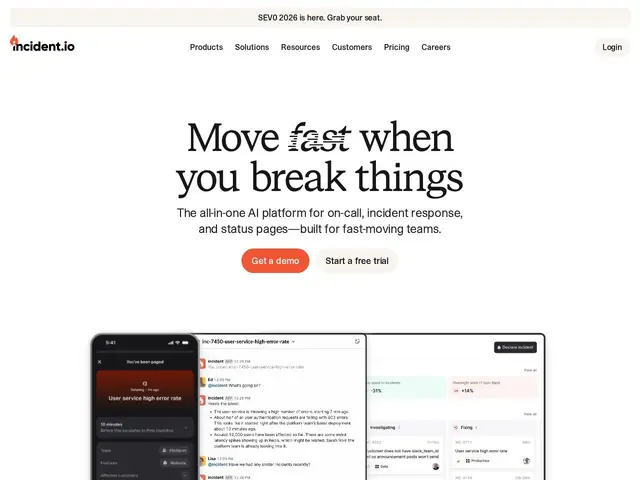
Description
Coordinating a production incident often means jumping between a paging tool, a chat app, a doc for notes, and a separate status page to tell customers what's happening — four different tools during the worst possible moment to be context-switching. incident.io keeps almost everything inside Slack (or Teams) itself, with AI investigating alongside the team and drafting fixes, and automatically updates a public status page as the incident progresses. incident.io covers AI-powered on-call scheduling and alerting, deeply Slack/Teams-integrated incident coordination, AI-driven investigation that suggests fixes and can draft pull requests, automated customer-facing status pages, a "Catalog" feature for storing contextual system information agents and humans can reference, workflow automation for repeatable incident processes, and analytics for spotting trends across past incidents. Its named customer base (Netflix, Airbnb, Etsy, Linear) spans some of the most operationally demanding companies in tech.
💬 Our review
The short version: incident.io's Slack-native design philosophy is its clearest differentiator — rather than adding a Slack integration to a separate incident tool, the whole workflow lives inside the chat app engineers already have open, which removes the friction of switching tools mid-crisis.
Having the AI draft an actual pull request as part of investigating a fix (not just suggesting where to look) is a genuinely further step than most incident tools take, closing more of the loop from "something's broken" to "here's a proposed fix" without a human doing every intermediate step. Its customer roster — Netflix, Airbnb, Etsy, and notably Vanta (itself a serious enterprise SaaS company) — is about as strong a signal as this category offers, since these are companies with real incentive to churn off a tool that doesn't hold up under genuine production pressure. The honest caveat: its pricing tiers stack up quickly once on-call add-ons are included ($19-25/user/month base plus $10-20/user/month for on-call), so a mid-size engineering team should model the real per-user cost carefully rather than anchoring on the entry price alone, and — as with any vendor — its G2 "Leader" badges are worth a quick independent check on G2's site for the current standing rather than assumed permanent. Against Rootly, which offers more startup-friendly discount tiers, incident.io's customer base skews toward larger, already-scaled engineering organizations.
💰 Pricing
📊 Global score
🤖 AI-enriched data
Pros
Fully Slack/Teams-native workflow, not a bolt-on integration
AI investigation can draft an actual pull request as part of the fix, not just point to a cause
Named large-scale customers (Netflix, Airbnb, Etsy, Vanta)
Automated customer-facing status pages built in
Cons
Pricing stacks up quickly once on-call add-ons are included
Skews toward larger, already-scaled engineering organizations
G2 award badges should be independently re-checked for current standing
❓ Frequently asked questions
- Do I need to leave Slack to manage an incident with this tool?
- No — nearly the entire workflow, from coordination to AI investigation, is built to live inside Slack or Teams directly, rather than requiring a switch to a separate app.
- Can the AI actually fix something, or just point at the problem?
- It goes further than most competitors — it can draft an actual pull request as part of its investigation, not just suggest where the issue might be.
- Does it handle customer communication during an outage?
- Yes, it includes automated customer-facing status pages that update as the incident progresses.
- Is it worth the money compared to alternatives?
- For a larger, operationally mature engineering org, its Slack-native depth and AI fix-drafting are worth the cost — but model the real per-user price once on-call add-ons are included, since it adds up faster than the entry-tier price suggests.
- Which tool should you pick for your case?
- Larger engineering org (100+ engineers) wanting the deepest Slack-native AI incident workflow: incident.io. Smaller or younger team wanting more accessible startup pricing: Rootly.