Correlated
Tool that watches how people actually use your free or trial software and tells your sales team exactly who's ready to buy, instead of cold-calling a random list.
🔗 Visit Correlated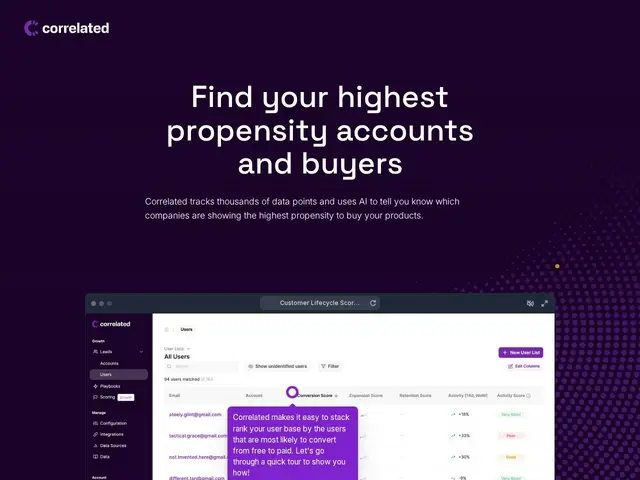
Description
When a company lets people try its product for free before buying, the earliest and best sign someone's ready to become a paying customer isn't in a spreadsheet — it's in how they're actually using the product. Correlated reads that usage data directly, scores each account on how likely it is to convert, and routes the promising ones straight to a salesperson, so reps spend their time on people already showing real interest instead of cold-prospecting a static list. Correlated combines AI-powered account prioritization and product-qualified-lead (PQL) scoring with a "Customer 360" view that pulls in usage, CRM and support data without custom engineering work, automated routing into a sales team's existing playbooks, and GPT-4-powered enrichment of account data. It integrates with 20+ tools including Salesforce, HubSpot, Outreach, Salesloft and major data warehouses.
💬 Our review
The short version: Correlated's core idea — that product usage data predicts who's ready to buy better than a cold contact list — has real evidence behind it (PLG companies that adopt PQL scoring report meaningfully higher conversion than traditional cold-outreach funnels), and Correlated was one of the earlier, more established players building specifically for that workflow.
A meaningful market signal worth knowing before evaluating this category: Correlated's most direct competitor, Pocus, was acquired by Apollo.io in March 2026 and became waitlist-only, effectively removing a major alternative from the market — Correlated, independently confirmed still operating as of mid-2026, is now one of the more established standalone options left in this specific niche. No-code data connectivity (pulling usage, CRM and support signals together without requiring engineering time to wire it up) is the practical feature that determines whether a sales team's ops function can actually maintain this themselves versus needing a data engineer on call. The honest caveat: as with any PLG/PQL vendor, specific conversion-lift numbers (5-6x versus MQLs, cited industry-wide) are aggregate figures, not a guarantee for your specific product and funnel — worth validating against your own trial-to-paid data during a pilot.
💰 Pricing
📊 Global score
🤖 AI-enriched data
Pros
One of the more established standalone PQL/product-led-sales platforms remaining after Pocus's acquisition
No-code data connectivity across usage, CRM and support data
GPT-4-powered account enrichment
20+ integrations with major CRM/sales-engagement tools
Cons
No public pricing, custom enterprise sales
Industry-wide PQL conversion-lift figures are aggregate claims, not a guarantee for any specific product
A narrower category focus than a broader GTM platform like Clay
❓ Frequently asked questions
- What is a product-qualified lead (PQL), and how does Correlated find them?
- A PQL is a lead identified as ready to buy based on how they actually use your product (a trial or free tier), rather than demographic or firmographic guessing. Correlated scores accounts on this usage data and routes the strong ones to sales.
- Is Correlated still an independent company?
- Yes — as of mid-2026 it's confirmed still independently operating, unlike its most direct competitor Pocus, which was acquired by Apollo.io in March 2026 and became waitlist-only.
- Do I need engineering help to set this up?
- No — it's designed with no-code data connectivity to pull in usage, CRM and support data without custom integration work.
- Is it worth the money compared to alternatives?
- For a genuine product-led-growth company with real trial/usage data to mine, yes — the category's conversion-lift evidence is real, though the specific multiplier for your product should be validated in a pilot rather than assumed from industry-wide averages.
- Which tool should you pick for your case?
- Specifically want PQL scoring and product-usage-based sales routing: Correlated. Want a broader community-plus-product-signal GTM platform: Common Room.