ALICE Technologies
AI scheduling tool for construction that generates and compares thousands of possible project timelines to find the fastest, cheapest way to build something.
🔗 Visit ALICE Technologies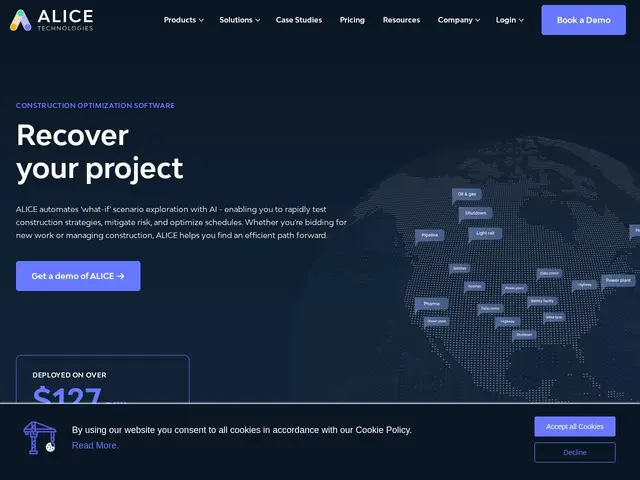
Description
A construction schedule isn't just one plan — there are usually dozens of legitimate ways to sequence the same project, each with different tradeoffs between speed, cost and risk, and a human planner can only realistically work through a handful of them by hand. ALICE Technologies uses AI to generate and compare a huge number of these possible schedules automatically, then shows a planner exactly which approach hits their real priorities — finishing fastest, spending least, or minimizing risk. ALICE Plan overlays a 2D schedule directly on construction drawings so it's easy to see what's happening where, ALICE Optimize runs what-if scenario analysis starting from an existing schedule built in P6 or Microsoft Project, ALICE Model generates a schedule directly from a BIM (building information model), and a newer Schedule Insights Agent lets a planner ask questions about a schedule in plain language. A Schedule Quality Score checks a plan against DCMA (industry) compliance standards automatically.
💬 Our review
The short version: ALICE's real differentiator is generating and comparing many possible construction schedules at once rather than helping refine the one schedule a planner already came up with — it's optioneering, not just optimization of an existing plan.
Starting from a BIM model (ALICE Model) rather than requiring a schedule to already exist is the most technically interesting capability here — it means a project team can explore scheduling options during early design, before a traditional schedule would normally even be built, which shifts scheduling from a downstream task to an upstream planning input. The named customer list (Costain, Parsons, Kajima, and the HS2 rail megaproject in the UK) spans large infrastructure players specifically, suggesting this tool proves its value most clearly on genuinely complex, large-scale projects where the number of valid sequencing options is actually large enough to matter. The honest caveat: on a small, straightforward project with few real scheduling alternatives, the value of comparing "thousands of paths" shrinks considerably — this is a tool built for and proven on large, complex infrastructure and construction programs, not a simple renovation job. As with any vendor's own numbers, the specific efficiency figures (17% duration reduction, 14% labor savings) lack disclosed methodology and should be treated as directional rather than guaranteed for your specific project type.
💰 Pricing
📊 Global score
🤖 AI-enriched data
Pros
Generates and compares many possible schedules (optioneering), not just refining one existing plan
Can build a schedule directly from a BIM model, before a traditional schedule exists
Proven on large infrastructure megaprojects (HS2, Costain, Kajima)
Automated DCMA compliance scoring for schedule quality
Cons
Value shrinks considerably on small projects with few real scheduling alternatives
No public pricing, fully custom enterprise sales
Efficiency-gain figures lack disclosed methodology
❓ Frequently asked questions
- How is ALICE different from a normal scheduling tool?
- Instead of helping refine a single schedule you already built, it generates and compares many valid alternative sequences for the same project, so you can pick based on your actual priority — speed, cost or risk.
- Do I need an existing schedule to use it?
- No — ALICE Model can generate a schedule directly from a BIM (building information model), letting scheduling happen earlier in the project than usual.
- Is this only useful for huge infrastructure projects?
- It's proven most clearly there (HS2, Costain, Kajima) because large, complex projects have genuinely many valid scheduling paths to compare — the value is much smaller on a simple, small project.
- Is it worth the money compared to alternatives?
- For a large, complex construction or infrastructure program with real scheduling flexibility, the optioneering approach can be genuinely valuable — validate the specific efficiency numbers against your own project type rather than assuming they transfer directly.
- Which tool should you pick for your case?
- Large, complex project needing many schedule options compared: ALICE Technologies. Simpler estimating/takeoff need: Togal.AI. Broad day-to-day project management across a whole company: Procore.