Agentcard
Issues single-use virtual Visa cards for AI agents, so an agent can autonomously pay for something within a strict spending limit that closes automatically after one charge.
🔗 Visit Agentcard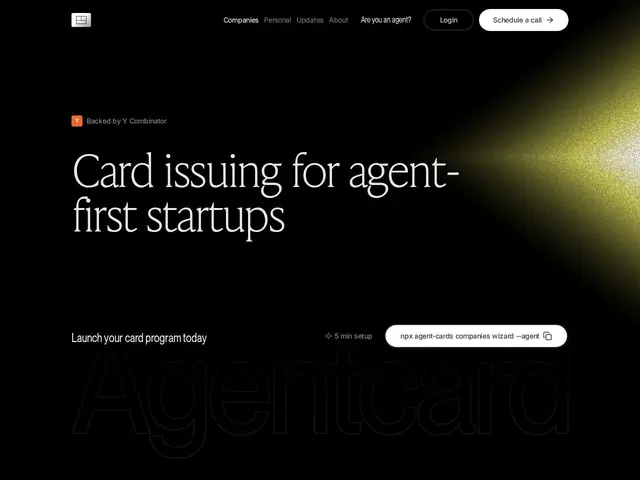
Description
Letting an AI agent make its own purchases sounds risky — what if it overspends, gets charged twice, or a bug sends it on a shopping spree. Agentcard's answer is to make the payment method itself impossible to abuse: it issues a virtual debit card capped at a specific dollar amount that automatically closes after being charged once, so an agent literally cannot spend more than it was authorized for, no matter what goes wrong in its reasoning. Agentcard connects natively to the Model Context Protocol (MCP) used by Claude and other AI coding/agent tools, lets a developer fund a wallet via Apple Pay or Google Pay, supports human-in-the-loop approval for sensitive purchases, and offers a conversational "buy" tool an agent can call to complete a purchase end-to-end. OAuth 2.1 with PKCE and signed webhooks support integrating it into a larger platform issuing cards to many end users, not just a single developer's personal use.
💬 Our review
The short version: Agentcard's core safety mechanism — a card that's both capped and self-destructing after one charge — is a genuinely clean way to bound the financial risk of letting an AI agent spend money, simpler and more concrete than trying to constrain an agent's behavior through prompting alone.
Native MCP support is the practical hook that matters for adoption: a developer using Claude or another MCP-compatible agent tool can wire in payment capability without building custom card-issuing integration from scratch, which is a real time-saver over going directly to a general payments API like Stripe Issuing. The tiered personal pricing (free up to $50/card, up through $100/month for higher limits) makes it approachable to try for an individual developer experimenting with agent-driven purchases before considering a larger platform integration. The honest caveat: this is a very new, small (2-person) YC S26 company with no enterprise/team tier visible yet and limited independently confirmed track record — appropriate for prototyping and personal use today, but a company building a production system with real financial exposure should evaluate its reliability and support model carefully before depending on it, same caution warranted for any very early-stage fintech infrastructure provider. Against Orthogonal (which gives agents API access to many third-party services with pay-per-call billing) Agentcard solves a narrower, different problem specifically — issuing a payment instrument an agent can use anywhere a card is accepted, rather than brokering access to a curated set of APIs.
💰 Pricing
📊 Global score
🤖 AI-enriched data
Pros
Cards are hard-capped and self-close after one charge, bounding financial risk concretely
Native MCP support for direct integration with Claude and similar agent tools
Human-in-the-loop approval available for sensitive purchases
Approachable free/low-cost personal tiers for individual developer experimentation
Cons
Very new, small (2-person) company with limited independently confirmed track record
No visible enterprise/team tier for larger production deployments
Narrower scope than a general agent-API-access platform like Orthogonal
❓ Frequently asked questions
- How does Agentcard prevent an AI agent from overspending?
- Each virtual card is issued with a hard dollar cap and automatically closes after being charged once, so an agent physically cannot spend more than authorized, regardless of what its reasoning decides to do.
- Does it work with Claude or other AI agent tools directly?
- Yes — it has native Model Context Protocol (MCP) support, so it integrates directly with Claude and other MCP-compatible agent tools without custom payment-integration code.
- Can a human approve a purchase before it happens?
- Yes, human-in-the-loop approval is supported for sensitive purchases, alongside a fully autonomous "buy" tool for end-to-end agent-driven purchases.
- Is it worth the money compared to alternatives?
- For prototyping or personal use, the free/low-cost tiers make it an easy way to test agent-driven purchasing safely — for a production system with real financial exposure, weigh its early-stage status carefully against a more established general payments API like Stripe Issuing.
- Which tool should you pick for your case?
- Need a capped, self-closing payment instrument specifically for an AI agent: Agentcard. Need broader access to many third-party APIs with pay-per-call billing, not just payment cards: Orthogonal. Building custom card-issuing infrastructure at larger scale: Stripe Issuing directly.