hireEZ
Agentic AI recruiting platform that sources, screens and schedules candidates on top of a company's existing applicant tracking system, without replacing it.
🔗 Visit hireEZ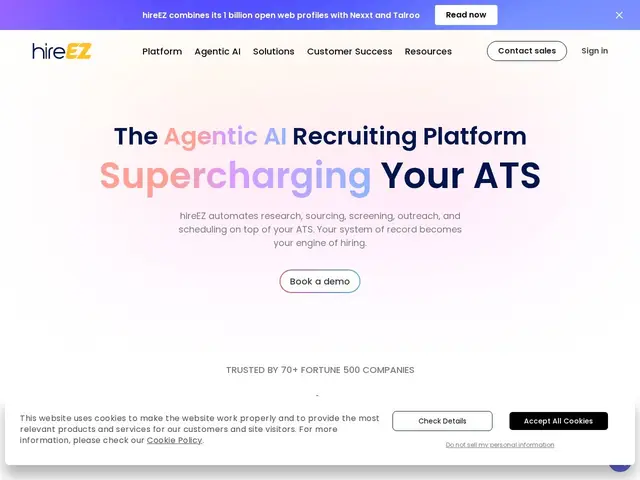
Description
Most recruiting software wants a company to rip out its existing hiring system and replace it entirely — a painful, months-long migration most talent teams would rather avoid. hireEZ takes a different approach: it adds AI-powered sourcing, screening and scheduling on top of whatever applicant-tracking system a company already uses, so recruiters get the AI upgrade without a disruptive system swap. hireEZ sources candidates across 45+ platforms using AI, runs conversational AI screening of applicants, automates interview scheduling, maintains a talent CRM for nurturing a pipeline over time, and provides hiring-process analytics — all layered on top of an existing ATS rather than requiring one. It's used by 70+ Fortune 500 companies across technology, healthcare, financial services, defense/aerospace, insurance and manufacturing.
💬 Our review
The short version: hireEZ's core pitch — AI recruiting capability without replacing your existing ATS — solves a real, practical adoption problem that many competing recruiting platforms create by requiring a full system migration.
Sourcing across 45+ platforms plus conversational AI screening genuinely cuts the manual grind of the earliest recruiting stages (finding and doing a first pass on candidates), and 70+ Fortune 500 customers spanning regulated industries (defense/aerospace, financial services, insurance) suggests it holds up under compliance-sensitive enterprise scrutiny, not just fast-moving startups. The honest caveat is that hireEZ, like most enterprise recruiting tools, is quote-only with no public pricing, and its published efficiency metrics (50% reduction in time-to-fill, 60%+ cost reduction) come without disclosed baselines or methodology — a candidate for direct validation in a sales pilot rather than a number to plan a budget around. Against newer, more narrowly-scoped tools like Mokka (which leans harder into fraud/integrity detection for AI-generated candidate submissions, a newer problem hireEZ's marketing doesn't emphasize as much), hireEZ's advantage is breadth and enterprise-proven scale; Mokka's is a sharper focus on one emerging risk (candidates using AI to fake screening responses).
💰 Pricing
📊 Global score
🤖 AI-enriched data
Pros
Layers on top of an existing ATS rather than requiring a replacement
AI sourcing across 45+ platforms
Proven at Fortune 500 scale across regulated industries
Conversational AI screening plus automated scheduling
Cons
No public pricing — quote-only enterprise sales
Efficiency metrics (time-to-fill, cost reduction) lack disclosed baselines
Less specialized than newer tools focused on a single emerging problem (e.g. AI-candidate fraud detection)
❓ Frequently asked questions
- Do I have to replace my existing ATS to use hireEZ?
- No — it's designed to add AI sourcing, screening and scheduling on top of whatever ATS you already run, rather than requiring a full system replacement.
- How does its candidate sourcing work?
- AI-driven sourcing across 45+ platforms, combined with conversational AI screening to do a first pass on applicants before a recruiter gets involved.
- Is hireEZ used by large enterprises?
- Yes — 70+ Fortune 500 companies across regulated industries like defense/aerospace, financial services and insurance, alongside tech and healthcare.
- Is it worth the money compared to alternatives?
- The ATS-agnostic approach avoids a costly migration, which is a real cost saver versus platforms that require replacing your existing system — but validate the specific time-to-fill and cost-reduction claims in a pilot with your own data before budgeting around the vendor's published numbers.
- Which tool should you pick for your case?
- Want AI recruiting layered on your current ATS at enterprise scale: hireEZ. Specifically worried about AI-generated fake candidate applications: Mokka. Need deep talent-intelligence analytics across a large internal workforce: Eightfold.