Abridge
AI platform that listens to doctor-patient conversations and automatically writes the clinical documentation, freeing physicians from typing notes during appointments.
🔗 Visit Abridge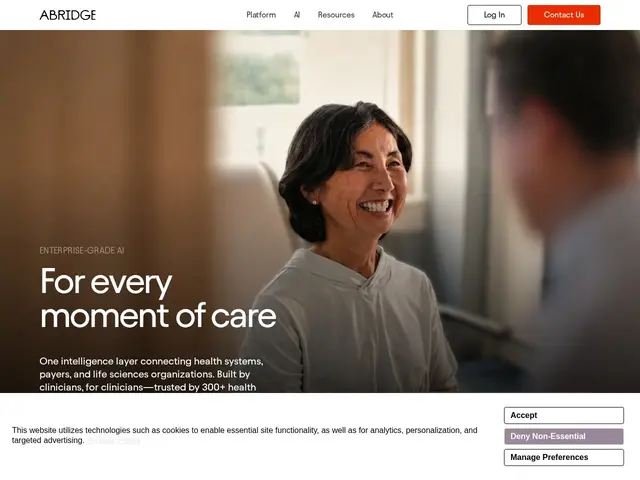
Description
Doctors spend a shocking amount of their day typing notes about the patient they just saw, instead of looking at the patient — a big reason physician burnout is so common. Abridge fixes that by listening to the actual conversation during a visit (with consent) and turning it into a proper clinical note automatically, so the doctor can focus on the patient instead of the keyboard. Abridge captures real-time conversation and clinical decision support during a visit, compiles pre-visit patient history and context, generates automated documentation with source citations linked back to the original conversation (its "Linked Evidence" feature), flags care gaps, and integrates natively into Epic (the dominant hospital record system) alongside Oracle Health and other major EHRs. It also extends into nursing documentation and prior-authorization paperwork, and supports 28+ languages. It's KLAS-rated the top ambient AI platform two years running and has raised nearly $780M, reaching a $5.3B valuation as of its most recent round.
💬 Our review
The short version: Abridge is the current market leader in AI medical scribing, both by customer count (300+ health systems including Mayo Clinic, Johns Hopkins and Kaiser Permanente) and by independent ranking (KLAS Market Leader for Ambient AI in 2025 and 2026) — a strong signal in a category where marketing claims are otherwise hard to verify from outside.
The "Linked Evidence" design — every generated note ties back to the specific part of the conversation it came from — is the feature that actually matters for clinical and legal safety: a doctor (or auditor) can check exactly why the AI wrote what it wrote, rather than trusting an unexplained summary. Deep, native Epic integration is also a genuine practical advantage, since Epic runs a large share of U.S. hospital records and a scribe tool that lives awkwardly outside the EHR gets used less. The honest caveat, true of this entire category (Abridge, Nabla, Suki): pricing is enterprise-only and undisclosed, so a smaller practice can't get a quick self-serve quote, and vendor-reported adoption/time-saved statistics (including Abridge's own) should be checked against independent KLAS data rather than taken at face value — which, in Abridge's specific case, happens to hold up better than most competitors given its top KLAS ranking. Against Nabla (also strong on language breadth and EHR integration but has moved to fully hidden pricing) and Suki (which leans more into voice-driven active commands than pure ambient listening), Abridge's edge is scale of hospital-system adoption and the independently-verified top ranking.
💰 Pricing
📊 Global score
🤖 AI-enriched data
Pros
KLAS Market Leader for Ambient AI, 2 years running — independently verified, not just vendor-claimed
Linked Evidence ties every note back to its source conversation
Native Epic integration (Haiku/Hyperspace), the dominant hospital EHR
300+ health systems, including Mayo Clinic, Johns Hopkins, Kaiser Permanente
Cons
Enterprise-only, no public pricing or self-serve tier
Only genuinely proven at hospital-system scale, less accessible for small practices
❓ Frequently asked questions
- How does Abridge protect against the AI writing something wrong in a medical note?
- Its "Linked Evidence" feature ties every generated statement back to the specific part of the conversation it came from, so a clinician can verify why the note says what it says rather than trusting an opaque summary.
- Does it work with our existing hospital records system?
- Yes — Abridge has native integration with Epic (the most widely used U.S. hospital EHR) as well as Oracle Health and other major systems.
- Is Abridge only for doctors, or other clinical staff too?
- It's expanded beyond physician documentation into nursing documentation and prior-authorization paperwork automation as well.
- Is it worth the money compared to alternatives?
- Its independent #1 KLAS ranking two years running is a genuine differentiator in a category where most vendor claims can't be externally verified — worth prioritizing in a bake-off against Nabla or Suki specifically because of that outside validation, though exact ROI still depends on your health system's size and workflow.
- Which tool should you pick for your case?
- Large hospital system, deep Epic integration needed: Abridge. Multi-language, multi-specialty international clinic: Nabla. Prefer voice-command-driven active workflows over pure ambient listening: Suki.