Mechanical Orchard
AI platform (Imogen) that rewrites legacy mainframe systems — COBOL, CICS, DB2 — into modern cloud code by replicating exact behavior, not just translating syntax.
🔗 Visit Mechanical Orchard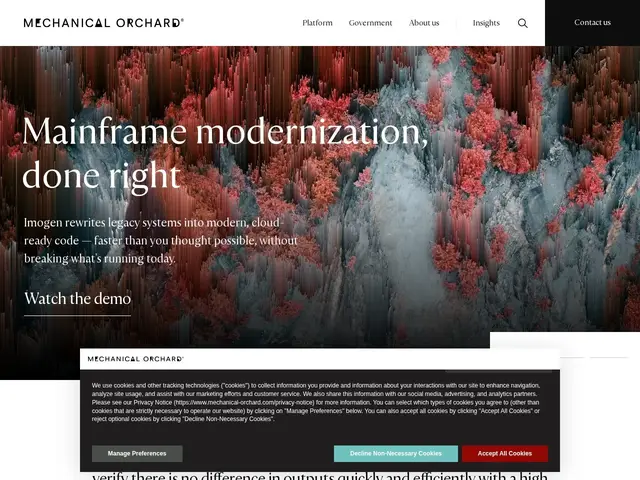
Description
Banks, airlines and government agencies still run huge chunks of their operations on mainframe computer systems written decades ago, often in a language called COBOL, by programmers who are now retiring faster than replacements can be trained. Rewriting that code by hand is slow and risky — one mistake can break something critical, like a payroll system or an ATM network. Mechanical Orchard built a platform called Imogen that uses AI to rewrite that old code into modern software while checking, step by step, that it still behaves exactly the same way as the original. Imogen has three parts: Analyze maps the legacy system deterministically rather than guessing at its structure, Rewrite generates new, test-driven code based on the mapped behavior, and Orchestrate lets the old and new systems run side by side during a gradual migration instead of a risky all-at-once cutover. It supports COBOL, PL/1, Assembler and Easytrieve source code running on z/OS, CICS, IMS, DB2 and VSAM — the specific stack most large mainframes actually run. It's an enterprise services engagement, not self-serve software, and it's available through the AWS and Google Cloud marketplaces as well as U.S. federal procurement channels.
💬 Our review
The short version: Mechanical Orchard exists because rewriting 40-year-old banking or government software by hand is one of the highest-stakes, most understaffed problems in enterprise IT, and its pitch is doing that rewrite with continuous verification instead of hope.
The genuinely differentiated idea is "behavior replication, not code translation" — rather than mechanically converting COBOL syntax line-by-line into Java (which is what most AI-assisted modernization tools, including IBM's watsonx Code Assistant for Z and Amazon Q Code Transformation, primarily do), Imogen reverse-engineers what the system actually does and rebuilds it to match, verified against real production data before cutover. Having Kent Beck (co-creator of Extreme Programming and a well-known voice on software correctness) as chief scientist is a credible signal that the "verify constantly" philosophy is more than marketing. The honest reality: this is an enterprise services engagement costing real money over months, not a SaaS subscription — appropriate only for organizations with a genuine mainframe-scale problem (Fortune 500/government), not a startup with some old code to clean up. Against big-vendor alternatives (IBM, AWS, Google's own AI-assisted migration tools), Mechanical Orchard's edge is being vendor-neutral and behavior-first rather than tied to one cloud's migration path, at the cost of being a smaller, younger company than IBM or AWS to bet a mission-critical system on.
💰 Pricing
📊 Global score
🤖 AI-enriched data
Pros
Behavior-replication approach verified against real production data, not just syntax translation
Incremental migration (old and new systems run side by side) instead of risky big-bang cutover
Chief scientist Kent Beck lends credibility to the verification-first methodology
$74M raised across two rounds, available on AWS/Google Cloud marketplaces and federal procurement channels
Cons
Enterprise services engagement, not self-serve software — months-long sales and delivery cycle
Only appropriate at genuine mainframe scale, not smaller legacy-code cleanup
🔄 Alternatives to Mechanical Orchard
See all alternatives to Mechanical Orchard →❓ Frequently asked questions
- What legacy systems does Imogen support?
- COBOL, PL/1, Assembler and Easytrieve code running on z/OS, CICS, IMS, DB2, VSAM and IDMS — the stack most large enterprise mainframes actually run.
- How is this different from just having AI translate COBOL to Java?
- Imogen maps what the legacy system actually does (deterministically, not by guessing) and rebuilds it to replicate that exact behavior, verified against live production data — rather than mechanically converting syntax line by line, which is what most competing tools do.
- Do you have to switch everything over at once?
- No — the Orchestrate module lets the legacy and modernized systems run side by side, so migration happens incrementally instead of one risky cutover event.
- Is it worth the money compared to alternatives?
- For a Fortune 500 or government agency facing a genuine mainframe-modernization risk (retiring COBOL programmers, aging systems nobody fully understands anymore), yes — the cost of a failed big-bang migration dwarfs the services fee. For a smaller company with dated but non-mainframe code, this is the wrong tool; look at general AI coding-agent modernization support instead.
- Which tool should you pick for your case?
- Genuine mainframe (COBOL/CICS/DB2) modernization at enterprise scale: Mechanical Orchard. Already committed to IBM's mainframe ecosystem: IBM watsonx Code Assistant for Z. Already an AWS shop doing Java version upgrades: Amazon Q Code Transformation. Want an all-in-one modernization + DevOps platform: BMC AMI DevX.