Decagon
AI-native customer support platform that builds conversational agents handling voice, chat and email tickets end-to-end for large companies.
🔗 Visit Decagon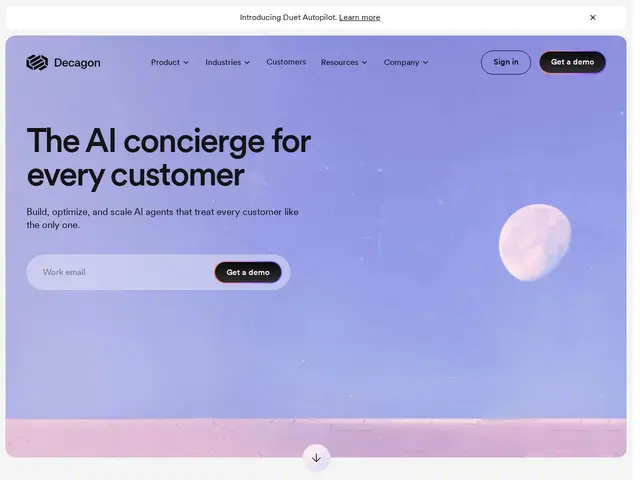
Description
When you contact customer support online today, there's a decent chance a piece of software — not a person — answers first, checks your order, and either solves the problem or hands you off to a human. Decagon is one of the companies building that software: instead of a scripted chatbot that only handles a few pre-written questions, it builds AI agents that can actually look things up, take actions like issuing a refund, and hold a real conversation across chat, voice, and email. Decagon lets companies define agent behavior in plain-language "Agent Operating Procedures" rather than rigid decision-tree scripts, deploys the same agent across chat, voice and email, and includes built-in testing/simulation tools, A/B experiments, and a continuous quality-monitoring layer called Watchtower. It connects to a company's existing tools (order systems, CRMs, ticketing) to actually resolve issues rather than just answer questions about them. It's sold purely as an enterprise product — no self-serve tier, no public pricing.
💬 Our review
The short version: Decagon is aimed at large companies that want AI to actually resolve support tickets — refunds, bookings, cancellations — not just answer FAQs, and its client list (Duolingo, Chime, Oura) shows it's landing that pitch at real scale.
The strongest part of the product is the shift from scripted chatbot logic to plain-language "Agent Operating Procedures" plus genuine tool integrations — that's the difference between a bot that can tell you your order status and one that can actually process your return. Watchtower, its continuous QA layer, addresses a real and under-discussed problem with AI support agents: without ongoing monitoring, an agent's answers silently drift or start hallucinating steps, and most competitors don't advertise anything comparable. The honest caveat is that every deflection-rate and cost-savings number in Decagon's marketing (80% deflection at Duolingo, 95% cost reduction at ClassPass) is self-reported by the vendor with no independent audit methodology disclosed — treat those as directional, not guaranteed for your own ticket mix. Against Intercom's Fin (bundled into an existing helpdesk you may already own) and Ada (similarly enterprise-focused), Decagon differentiates mainly on its omnichannel voice+chat+email parity and its outcome-testing tooling, at the cost of being a separate platform to integrate rather than a bolt-on to a helpdesk you already run.
💰 Pricing
📊 Global score
🤖 AI-enriched data
Pros
Plain-language Agent Operating Procedures instead of rigid decision trees
True omnichannel: voice, chat and email from one agent
Watchtower continuous QA monitoring built in, not bolted on
Cons
No self-serve tier or public pricing — enterprise sales cycle only
Deflection-rate and savings claims are vendor-reported, not independently audited
🔄 Alternatives to Decagon
See all alternatives to Decagon →❓ Frequently asked questions
- What channels does Decagon's AI agent support?
- Voice, chat and email from a single agent definition, rather than separate bots per channel.
- Can it actually resolve issues, not just answer questions?
- Yes — it connects to a company's existing systems (order management, CRM, ticketing) to take real actions like processing a refund, not just describe what the customer could do.
- How does Decagon make sure the AI stays accurate over time?
- Watchtower, its continuous quality-monitoring layer, checks agent conversations on an ongoing basis rather than relying on a one-time launch review.
- Is it worth the money compared to alternatives?
- For a large company with high support volume, the case is strong if even a fraction of the claimed deflection rates hold for your ticket mix — but validate that in a pilot rather than trusting the vendor's headline numbers, and compare seriously against Intercom's Fin if you already run Intercom as your helpdesk.
- Which tool should you pick for your case?
- Large enterprise wanting a standalone omnichannel AI agent platform: Decagon. Already using Intercom as your helpdesk: Intercom Fin. Technical/regulated B2B SaaS (fintech, healthtech): Lorikeet. Want to stay on your current helpdesk with an AI layer added: Ada.