Cactus Compute
Open-source on-device AI runtime that runs LLMs, vision models and speech models directly on phones, laptops and wearables — no cloud round-trip required.
🔗 Visit Cactus Compute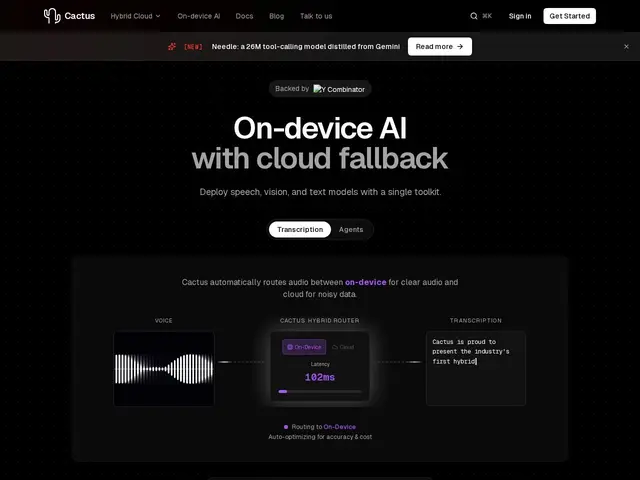
Description
Most AI apps send your data to a company's servers to get an answer back, which costs money per request and adds a delay. Cactus flips that: it's a piece of software that runs the AI model directly on your phone or laptop, so the answer comes back in a fraction of a second and nothing about what you asked ever has to leave the device. For an app like a voice assistant or a transcription tool, that means it keeps working offline and stays private by default. Cactus is an open-source (MIT-licensed) inference engine for running LLMs, vision-language models and speech models locally on iOS, Android, macOS and wearables, with intelligent routing that can fall back to the cloud for tasks too heavy for the device. It reports sub-120ms on-device transcription latency and has become a launch partner for Liquid AI's on-device LFM2 model family, alongside Qualcomm and Ollama. Being YC-backed and open source under MIT, it sits in the same practical space vacated by Nexa AI, which was acquired by Qualcomm in 2026 and folded into Qualcomm's own GenieX runtime rather than continuing as an independent product.
💬 Our review
The short version: if you're building a mobile or wearable app that needs AI features without a per-request cloud bill or a privacy conversation, Cactus is a free, open-source way to run that AI locally.
What's genuinely useful here is the hybrid design — Cactus doesn't force an all-or-nothing choice between fully local and fully cloud; it routes lighter tasks on-device and can escalate heavier ones to the cloud, which matches how most real apps actually need to behave (an always-on wake-word detector should never leave the device; a long complex query might legitimately need more compute than a phone can offer). MIT licensing plus YC backing gives it more credibility than a random open-source side project, and being named a launch partner for Liquid AI's LFM2 models alongside Qualcomm and Ollama is a real signal of adoption, not just marketing. The category itself just went through consolidation worth knowing about: Nexa AI, one of the best-known names in on-device inference, was acquired by Qualcomm in March 2026 and its SDK is being absorbed into Qualcomm's own GenieX runtime rather than continuing independently — which leaves Cactus, llama.cpp and Apple/Google's native frameworks (Core ML, MLC LLM) as the more durable open options for teams that don't want to be locked into one chipmaker's tooling. The honest caveat: this is still a fast-moving, technical space — expect breaking changes between releases and plan for real engineering time to integrate it, not a drop-in SDK call.
💰 Pricing
📊 Global score
🤖 AI-enriched data
Pros
Free, open source (MIT), no per-request cloud cost
Hybrid on-device/cloud routing rather than all-or-nothing
Real-time on-device latency (sub-120ms reported for transcription)
Cross-platform: iOS, Android, macOS, wearables
Cons
Requires real engineering integration effort, not a drop-in API
Younger project than some cloud-native alternatives, expect breaking changes
Device hardware still limits which model sizes are practical on-device
🔄 Alternatives to Cactus Compute
See all alternatives to Cactus Compute →❓ Frequently asked questions
- What kinds of AI models can Cactus run on-device?
- LLMs, vision-language models and speech (transcription/TTS) models, running locally on iOS, Android, macOS and wearables.
- Is Cactus free to use?
- Yes, it's open source under the MIT license and free to self-host; there's no disclosed paid enterprise tier on the public site.
- Does it work without an internet connection?
- Yes — that's the point of on-device inference. Cactus can also route heavier tasks to the cloud when a device isn't powerful enough, rather than forcing an all-local or all-cloud choice.
- Is it worth the money compared to alternatives?
- It's free, so the real cost comparison is engineering time. Compared to sending every request to a cloud LLM API, on-device inference with Cactus eliminates per-request cost and latency for the tasks it can handle — worth it if privacy or offline support matters for your app, less worth it if your team would rather avoid the extra mobile engineering work.
- Which tool should you pick for your case?
- Cross-platform mobile app needing local LLM/speech inference for free: Cactus. Deep in the Apple ecosystem only: Core ML. Need frontier-model-quality on-device with vendor support: the chipmaker's own SDK (e.g. Qualcomm's GenieX, successor to Nexa AI). Server-side local inference rather than mobile: llama.cpp or MLC LLM.