Shotstack
Cloud API that turns a JSON description of a video — clips, text, transitions — into a rendered MP4, so apps can generate or personalize video automatically instead of a human editing it by hand.
🔗 Visit Shotstack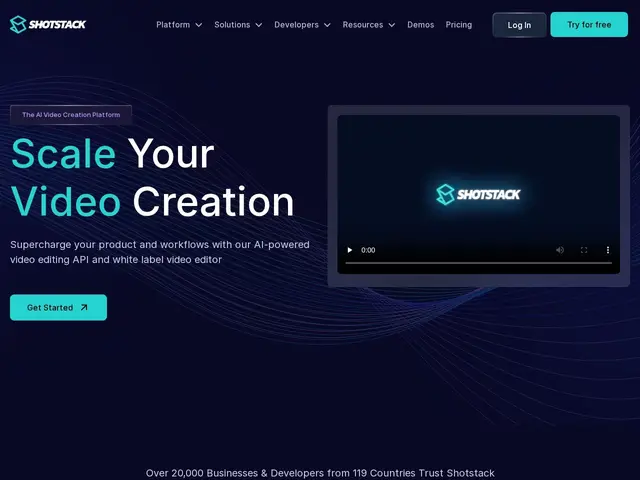
Description
If your app needs to spit out a finished video automatically — a personalized product demo, a highlight reel, a thousand slightly different ad variations — someone still has to do the actual video rendering. Shotstack is a cloud service that does that part: you send it a description of what the video should contain (a title screen, a clip, some text, a transition) and it renders the MP4 and hands it back, the same way a payment processor handles a credit card charge instead of you building banking infrastructure. Shotstack is a video-editing-as-API platform built around a JSON timeline: developers POST a spec describing clips, text overlays, audio tracks, transitions and aspect ratios, and the service renders it in the cloud and returns a downloadable video. It's aimed squarely at engineering teams automating video at scale — real-estate listing videos, e-commerce product videos, personalized marketing, podcast-to-video, data-driven video (charts and stats turned into clips) — rather than at people editing video by hand. SDKs cover JavaScript/Node, Python, PHP, Ruby and TypeScript, and the company reports customers including Spotify (which it says manages tens of thousands of music videos through the platform), real-estate video platform Aryeo, and news outlet ETX.
💬 Our review
The short version: Shotstack solves a narrow but real problem — rendering video from code instead of running your own FFmpeg cluster — and does it with a clean, well-documented JSON API that's genuinely faster to integrate than rolling your own pipeline.
The honest trade-off is that this is infrastructure, not a video editor: there's no UI for a human to tweak a cut, and the whole value proposition assumes your video needs are templatable and repetitive (thousands of similar renders) rather than bespoke. At $0.30/minute pay-as-you-go or $0.20/minute on the $39/month plan, costs scale roughly linearly with render volume, which is fine for automated pipelines but would add up fast for anyone tempted to use it as a general-purpose editor. Compared to Creatomate (a close JSON-to-video competitor with a similar template model) the two are largely interchangeable on paper — the deciding factor tends to be which SDK and template tooling fits your stack, not a large capability gap. Compared to rolling your own with FFmpeg or Remotion, Shotstack trades a recurring per-minute cost for not having to build and maintain rendering infrastructure yourself — worth it unless you're rendering enough volume that self-hosting FFmpeg on your own compute becomes meaningfully cheaper.
💰 Pricing
📊 Global score
🤖 AI-enriched data
Pros
API JSON claire, bien documentée, SDKs dans 5 langages
Facturation à l'usage — pas d'infrastructure vidéo à maintenir
Clients établis en production à volume (Spotify, Aryeo) qui valident la fiabilité à l'échelle
Cons
Pas d'éditeur visuel — pur outil pour développeurs, aucune interface pour un humain
Coût au rendu qui grimpe vite en très gros volume face à une infra FFmpeg auto-hébergée
N'a de sens que pour des vidéos templatées et répétitives, pas pour du montage sur-mesure
🔄 Alternatives to Shotstack
See all alternatives to Shotstack →❓ Frequently asked questions
- What is Shotstack used for?
- Automatically rendering video from code — personalized ads, real-estate listing videos, e-commerce product videos, data-driven video — by sending a JSON description of the timeline to its API instead of editing video by hand.
- Do I need video editing skills to use Shotstack?
- No — Shotstack is aimed at developers, not editors. You describe the video in JSON (clips, text, transitions) and the API renders it; there's no visual editing interface.
- How is Shotstack priced?
- Pay-as-you-go at $0.30/minute of rendered video, or a $39/month subscription that drops the rate to $0.20/minute with a monthly credit allowance; high-volume users get custom pricing.
- Can Shotstack handle large-scale automated video generation?
- Yes — the company reports Spotify uses it to manage tens of thousands of music videos and real-estate platform Aryeo renders listing videos for 30,000 agents through it.
- Is it worth the money compared to alternatives?
- For teams that need repetitive, templated video generation, yes — it's cheaper in engineering time than building and maintaining an FFmpeg rendering pipeline, and roughly price-comparable to its closest competitor Creatomate. It stops being worth it if your render volume is high enough that self-hosted FFmpeg compute would cost less than the per-minute fee.
- Which tool should you pick for your case?
- Want a managed JSON-to-video API with strong production track record: Shotstack. Want a very similar JSON-to-video competitor to compare pricing/templates against: Creatomate. Want full control and no per-minute fee (and are willing to run your own servers): self-hosted FFmpeg or Remotion.