Laminar
A dashboard that shows you exactly what your AI agent did, step by step, when it fails — every tool call, every sub-agent, every LLM response — instead of leaving you to guess from a wall of logs.
🔗 Visit Laminar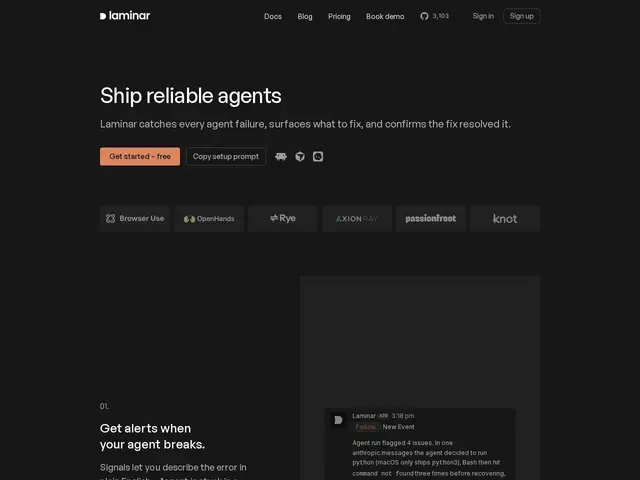
Description
When an AI agent goes wrong — takes the wrong action, loops forever, calls the wrong tool — figuring out why can mean digging through a mess of raw logs across dozens of steps. Laminar is built to make that debugging visual: it traces every LLM call, tool call and sub-agent your agent runs, whether the task finishes in one turn or hundreds of steps across parallel sub-agents, and lays it out so a developer can see exactly where things went sideways. Laminar is an open-source, OpenTelemetry-native observability platform purpose-built for AI agents (as opposed to general LLM apps), a Y Combinator S24 company with 3,100+ GitHub stars on its Apache 2.0-licensed core. It supports popular agent frameworks out of the box — Vercel AI SDK, Claude Agent SDK, OpenAI Agents SDK, LangGraph, Mastra, Browser Use, Stagehand — and adds features specific to agent debugging like automatic browser-agent tracing with synced window recordings, so you can watch what a browser-automation agent actually saw while it acted. It's Rust-powered on the backend for high trace throughput, and offers both managed Laminar Cloud and full self-hosting. Pricing runs Free (1GB, 7-day retention), Starter at $30/month (3GB, 30-day retention, unlimited seats), Pro at $150/month (10GB, 6-month retention), and custom Enterprise.
💬 Our review
The short version: Laminar's specific bet — that agent observability deserves purpose-built tooling rather than a general LLM-tracing tool stretched to cover agents — shows up clearly in features like synced browser-agent recordings that generic competitors like Langfuse or Braintrust don't offer the same way.
That specialization is also the trade-off: if your app is a straightforward single-turn LLM call rather than a multi-step agent, Laminar's agent-specific features are wasted and a more general tool may fit better. As an Apache 2.0 open-source project with real GitHub traction (3,100+ stars) and Series A funding, it's on solid footing, though it's still a much younger, smaller company than Braintrust or Langfuse. Pricing is straightforward and the free tier (1GB, 7-day retention) is enough to evaluate seriously before paying. For teams building genuinely agentic products — multi-step, multi-tool, possibly browser-automating agents — Laminar's specialization is a real advantage worth the switch; for simple chatbot-style LLM calls, a more general observability tool is probably sufficient.
💰 Pricing
📊 Global score
🤖 AI-enriched data
Pros
Spécialisé agents IA — traçage de chaque appel LLM/outil/sous-agent, y compris en parallèle
Enregistrements de navigateur synchronisés pour les agents de browser automation
Open source Apache 2.0 avec traction GitHub réelle (3100+ stars), self-hosting possible
Cons
Spécialisation agent inutile pour de simples appels LLM ponctuels
Entreprise plus jeune et plus petite que Braintrust ou Langfuse
Claim '20x plus efficace en stockage' non vérifié indépendamment
❓ Frequently asked questions
- What is Laminar used for?
- Tracing and debugging AI agents — every LLM call, tool call and sub-agent step — so developers can see exactly where a multi-step agent went wrong instead of digging through raw logs.
- Is Laminar open source?
- Yes, its core is Apache 2.0-licensed with 3,100+ GitHub stars, and it can be fully self-hosted or used as managed Laminar Cloud.
- Which agent frameworks does Laminar support?
- Vercel AI SDK, Claude Agent SDK, OpenAI Agents SDK, LangGraph, Pydantic AI, Mastra, Browser Use, Stagehand, and raw OpenAI/Anthropic clients.
- What makes Laminar different from general LLM observability tools?
- It's purpose-built for multi-step agents rather than single LLM calls, including features like synced browser-agent session recordings that show what a browser-automation agent actually saw.
- Is it worth the money compared to alternatives?
- For teams building genuinely agentic, multi-step products, yes — the agent-specific tracing and browser-recording features solve problems generic tools like Langfuse don't address the same way, and the free tier is generous enough to evaluate before paying $30/month for Starter.
- Which tool should you pick for your case?
- Building multi-step AI agents with tool calls and sub-agents: Laminar. Building simple single-turn LLM features: a more general tool like Langfuse. Want the most established enterprise-grade eval platform: Braintrust.