Vapi
Developer platform that wires together speech recognition, an AI model and speech generation into a working phone-answering voice agent.
🔗 Visit Vapi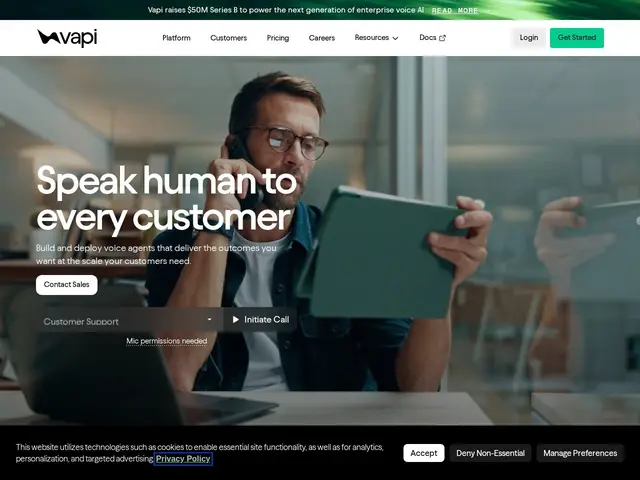
Description
Building a voice agent that can actually answer a phone call means connecting several separate pieces — something to turn speech into text, something to decide what to say back, something to turn that back into speech, and a phone system to carry the call — and making sure the whole chain responds fast enough that the caller doesn't notice any lag. Vapi packages that entire chain into one developer platform, so building a voice agent looks more like configuring a service than assembling five different vendors. Vapi lets developers configure and deploy voice AI agents that combine speech-to-text, an LLM, text-to-speech and PSTN (regular phone network) telephony integration, with infrastructure aimed at sub-500ms response latency. It includes real-time call monitoring and analytics, AI guardrails to reduce hallucinated responses during a live call, and compliance certifications (SOC 2, HIPAA, PCI) for regulated use cases. Pricing on the Build tier is usage-based — around $0.05/minute for hosting plus $10 per concurrent line per month — with underlying model provider costs (for STT, the LLM, and TTS) either passed through or waived if you bring your own API keys; a Scale tier with annual contracts and negotiated per-minute rates is available for higher-volume enterprise customers.
💬 Our review
The short version: Vapi's value is orchestration — it doesn't try to be the best speech-to-text or text-to-speech provider itself, it's the layer that wires best-in-class components together into a working phone agent, which saves real integration work compared to building that pipeline from scratch.
It competes directly with Retell AI and Bland AI in the "voice agent platform" category, all three solving a similar orchestration problem with broadly comparable latency targets and compliance certifications. The honest differentiator between them tends to be smaller things — Vapi's ability to bring your own model API keys to avoid provider markup, specific integration ecosystem, and pricing structure (per-concurrent-line rather than purely per-minute) — rather than a fundamental capability gap. For a team that wants control over which STT/LLM/TTS providers sit underneath the agent (to optimize cost or quality per component), Vapi's bring-your-own-key option is a real advantage over more locked-down competitors; for a team that just wants the fastest path to a working phone agent without those decisions, any of the three leading platforms will get the job done.
💰 Pricing
📊 Global score
🤖 AI-enriched data
Pros
Orchestrates STT, LLM, TTS and PSTN telephony into one working pipeline
Sub-500ms latency target for natural-feeling phone conversations
Bring-your-own API key option to control underlying model costs/quality
Cons
Competes closely with Retell AI and Bland AI with limited fundamental differentiation
Per-concurrent-line pricing ($10/line/month) plus usage adds real cost at scale
Underlying model provider costs are a separate variable to budget for
❓ Frequently asked questions
- What does Vapi actually build for me?
- It orchestrates the full pipeline needed for a phone-answering voice agent — speech-to-text, an AI model to decide the response, text-to-speech, and telephony to actually carry the call — so you configure one platform instead of integrating four separate vendors.
- Can I choose which AI model or speech provider Vapi uses?
- Yes — you can bring your own API keys for the underlying STT, LLM and TTS providers, which lets you control cost and quality at each step rather than being locked into Vapi's defaults.
- How fast does a Vapi voice agent respond?
- The infrastructure targets sub-500ms response latency, which is fast enough that a phone conversation feels natural rather than laggy.
- Is Vapi suitable for regulated industries like healthcare?
- Yes — it holds SOC 2, HIPAA and PCI compliance certifications, which matter for handling sensitive data in calls.
- Is it worth the money compared to alternatives?
- Pricing (~$0.05/min plus $10/concurrent line) is broadly comparable to Retell AI and Bland AI. The bring-your-own-API-key option can meaningfully lower total cost if you already have favorable rates with a specific STT/LLM/TTS provider — worth checking before assuming Vapi is cheaper or pricier than a competitor.
- Which tool should you pick for your case?
- Want control over which underlying speech/LLM providers power your agent: Vapi. Want a more drag-and-drop configuration experience: Retell AI. Need the widest telephony/PSTN feature set out of the box: compare Bland AI directly.