SuperAnnotate
Data annotation and evaluation platform that turns raw images, video, text and audio into labeled datasets for training and fine-tuning AI models.
🔗 Visit SuperAnnotate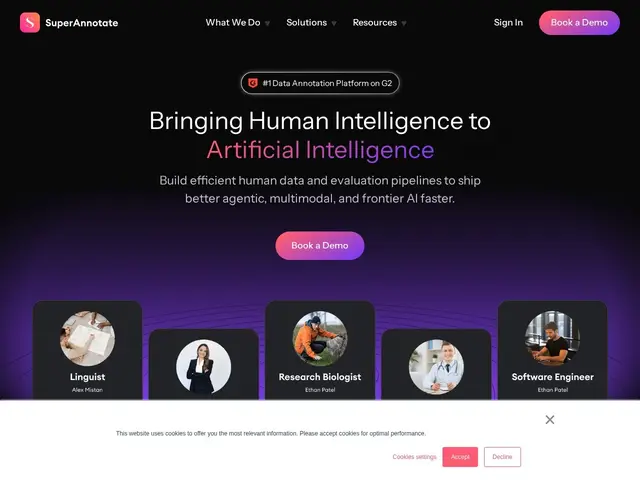
Description
A model is only as good as the examples it learns from, and turning raw, messy real-world data — photos, video clips, transcripts, audio — into clean, correctly labeled training examples is slow, detail-heavy work that doesn't scale well without dedicated tooling. SuperAnnotate provides that tooling: a workspace where teams (and outside reviewers) label data across multiple formats, check each other's work, and track whether labeling quality is actually good enough to trust. SuperAnnotate is a data annotation and AI evaluation platform supporting multimodal data — images, video, text and audio — with multi-layer annotation workflows that include expert review steps, integrations with AWS, GCP, Snowflake and Databricks for pulling data directly from existing pipelines, and dedicated tools for evaluating and reviewing AI agent outputs specifically. It provides quality-assurance analytics to track labeling accuracy and reviewer performance over time, along with a Python SDK and API for programmatic access. It's aimed at enterprise organizations and foundation-model builders; pricing isn't public and requires contacting sales.
💬 Our review
The short version: SuperAnnotate's strength is breadth across data types (image, video, text, audio) combined with built-in cloud-storage integrations, which reduces the friction of getting your existing data pipeline into an annotation workflow compared to tools that expect you to upload everything manually.
Its agent-evaluation and review tooling is a newer addition that puts it in similar territory to Labelbox's RL-focused expansion, though without the same scale of contracted expert reviewer network Labelbox offers through Alignerr. Against Encord, SuperAnnotate is less specialized in video/3D/LiDAR data specifically but broader in general multimodal coverage; against Kili Technology, both target similar enterprise, multi-project use cases with comparable certification profiles. The lack of public pricing is a real friction point common across this whole category — expect a sales conversation regardless of which platform you're evaluating, and use the cloud integrations and specific data-type support as the deciding factors rather than assuming meaningful price differences without asking.
💰 Pricing
📊 Global score
🤖 AI-enriched data
Pros
Multimodal support across images, video, text and audio in one platform
Built-in integrations with AWS, GCP, Snowflake and Databricks
Dedicated tools for evaluating and reviewing AI agent outputs
Cons
No public pricing — requires a sales conversation to evaluate
Less specialized than Encord for video/3D/LiDAR-specific workflows
Agent-evaluation features are newer and less proven than core annotation tooling
❓ Frequently asked questions
- What kinds of data can SuperAnnotate label?
- Images, video, text and audio — it's a multimodal platform rather than one focused on a single data type.
- Can SuperAnnotate connect to my existing cloud data?
- Yes — it has built-in integrations with AWS, GCP, Snowflake and Databricks, so you can pull data directly from an existing pipeline instead of manual uploads.
- Does SuperAnnotate help evaluate AI agents, not just label data?
- Yes, it includes dedicated tools for evaluating and reviewing AI agent outputs, alongside its core annotation workflows.
- How much does SuperAnnotate cost?
- Pricing isn't publicly listed — you'll need to contact sales to get a quote.
- Is it worth the money compared to alternatives?
- Without public pricing, it's hard to compare cost directly. The value case is strongest if you need multimodal annotation with built-in cloud data warehouse integrations — worth comparing against Labelbox and Kili Technology on your specific data types and existing infrastructure.
- Which tool should you pick for your case?
- Need multimodal annotation with direct cloud data warehouse integration: SuperAnnotate. Doing RLHF or agent post-training at scale: Labelbox. Labeling video, 3D or robotics sensor data specifically: Encord. Managing many concurrent annotation projects across varied formats: Kili Technology.