RunPod
Pay-by-the-second GPU cloud for training and running AI models, with no contracts and fast serverless cold starts.
🔗 Visit RunPod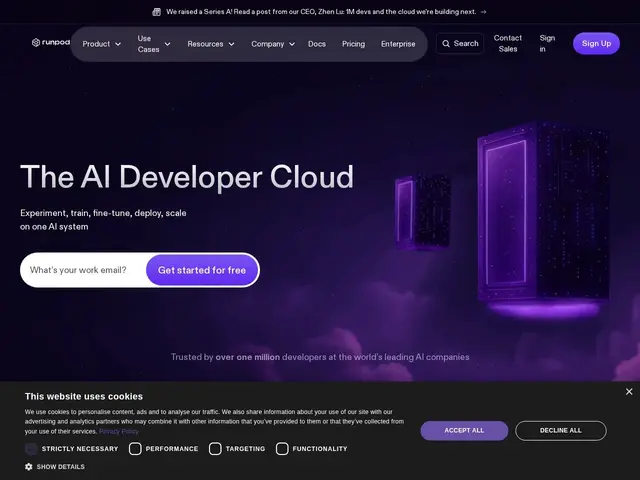
Description
Renting a powerful graphics card to train or run an AI model used to mean signing up with a big cloud provider, navigating complex pricing, and often waiting in a queue for capacity. RunPod strips that down to something closer to renting a car by the hour: pick a GPU, pay for exactly the time you use it down to the second, and stop paying the moment you're done. RunPod offers on-demand GPU infrastructure across three tiers — Pods (persistent instances), Serverless (autoscaling, pay-per-request), and Clusters (distributed multi-GPU workloads) — with more than 30 GPU types available across 31 global regions. Its Serverless tier uses "FlashBoot" to hit sub-200ms cold starts, which matters for applications that need a GPU to spin up on demand rather than sit idle and billed. Pricing is millisecond-level pay-as-you-go with no contracts or minimum commitments, roughly $0.27-$7.39/hour for persistent Pods and $0.58-$9.98/hour for Serverless depending on GPU type, plus storage costs. The company launched in October 2022, reports over a million developers on the platform, and lists customers including Hugging Face, Perplexity, Replit and Civitai; it holds SOC 2 Type II compliance with a 99.9% uptime guarantee.
💬 Our review
The short version: RunPod earns its reputation as the accessible, self-serve entry point into GPU cloud computing — no sales call, no minimum commitment, and pricing at the cheap end of the market makes it the natural first stop for an individual developer or small team that just needs a GPU right now.
Against Lambda, which leans into research-friendly workflows and longer-term reserved capacity, and CoreWeave, which targets large enterprise customers with dedicated multi-GPU node contracts, RunPod's pitch is flexibility and price at smaller scale — genuinely useful for prototyping, fine-tuning, or running inference without a procurement process. The honest trade-off is that self-serve, commodity GPU capacity from a smaller cloud can mean less predictable availability during high-demand periods compared to a hyperscaler or a provider with dedicated reserved capacity, and support is generally lighter-touch than an enterprise contract would provide. For individual developers and startups that want to start training or serving models today without a sales conversation, RunPod is a sensible default; for large, sustained production workloads, it's worth comparing reserved pricing against CoreWeave or Lambda first.
💰 Pricing
📊 Global score
🤖 AI-enriched data
Pros
Self-serve, no contracts or minimum commitments
Sub-200ms serverless cold starts via FlashBoot
30+ GPU types across 31 regions, generally cheaper than enterprise-focused competitors
Cons
Availability during high-demand periods can be less predictable than reserved/dedicated capacity
Lighter-touch support compared to an enterprise contract with CoreWeave or Lambda
Wide price range ($0.27-$9.98/hr) means real cost depends heavily on GPU choice
❓ Frequently asked questions
- Do I need a contract to use RunPod?
- No — pricing is pay-as-you-go down to the millisecond, with no contracts or minimum commitments, unlike many enterprise GPU cloud providers.
- What's the difference between Pods, Serverless and Clusters?
- Pods are persistent GPU instances you keep running, Serverless autoscales and bills per request with fast cold starts, and Clusters handle distributed multi-GPU workloads across machines.
- How fast does a RunPod Serverless GPU start up?
- Under 200 milliseconds using RunPod's FlashBoot technology, which matters for applications that need a GPU to spin up on demand rather than run continuously.
- Is RunPod reliable enough for production use?
- It holds SOC 2 Type II compliance and advertises a 99.9% uptime guarantee, and is used in production by companies like Hugging Face and Perplexity.
- Is it worth the money compared to alternatives?
- RunPod is generally priced at the cheaper end of the GPU cloud market, which makes it a good default for prototyping or moderate production use. For large, sustained enterprise workloads, it's worth comparing reserved pricing against Lambda or CoreWeave, which may offer better rates at guaranteed scale.
- Which tool should you pick for your case?
- Need cheap, self-serve GPU access without a sales process: RunPod. Want research-friendly workflows and reserved capacity: Lambda. Need enterprise-scale dedicated multi-GPU nodes with guaranteed uptime: CoreWeave.