Rime
Text-to-speech API built by linguists for hundreds of natural-sounding voices across 50+ languages, tuned for real conversation, not audiobooks.
🔗 Visit Rime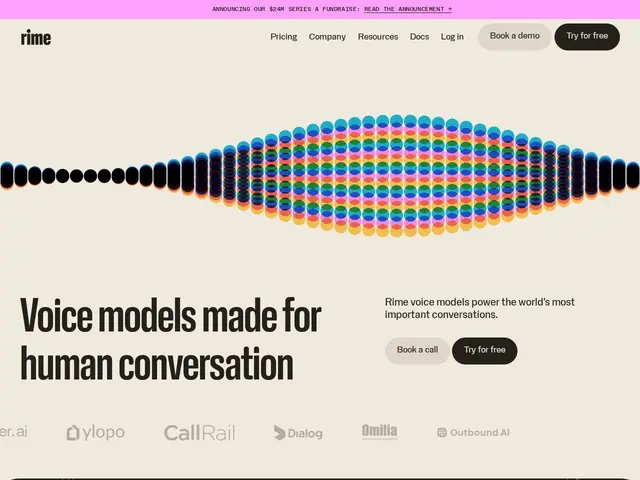
Description
Most text-to-speech voices still sound a little like they're reading a script rather than actually talking — fine for an audiobook, awkward for a customer service call. Rime was built by a team with a linguistics background specifically to close that gap, tuning speech generation for the rhythm, pacing and pronunciation quirks of real conversation rather than narration. Rime provides conversational voice models for enterprise AI agents, offering more than 600 voices across over 50 languages and regional dialects, with sub-100ms latency aimed at real-time voice agent use. It includes deterministic pronunciation controls — useful for correctly saying proper nouns, brand names or technical terms that a generic model would mispronounce — and supports on-premise and VPC deployment alongside HIPAA/BAA and SOC 2 compliance for regulated industries like fintech, healthcare and hospitality. Pricing runs at $0.05 per 1,000 characters, with 3,000 free minutes for new accounts and custom volume pricing for enterprise customers; the company has raised a Series A reported at $24M.
💬 Our review
The short version: Rime's specific bet — voices and language breadth built by people who study language for a living, rather than a general ML team bolting speech onto an LLM — shows up in the numbers that matter for this category: 600+ voices, 50+ languages with regional dialects, and pronunciation controls for the proper nouns that trip up generic models.
Against Cartesia, which competes hardest on raw latency (sub-100ms is genuinely fast but Cartesia markets similarly aggressive numbers), Rime's differentiation is closer to voice quality and language/dialect coverage than to being the single fastest option. Against Deepgram's bundled STT+TTS+orchestration approach, Rime is a narrower, TTS-focused bet. For a product that needs to sound convincingly human across many languages and regional accents — not just fast — Rime's linguistics-first approach is worth the evaluation; for a product operating in English only with a hard latency ceiling, Cartesia is the more directly comparable option to benchmark against.
💰 Pricing
📊 Global score
🤖 AI-enriched data
Pros
600+ voices across 50+ languages and regional dialects
Deterministic pronunciation controls for proper nouns and technical terms
Sub-100ms latency with on-premise/VPC deployment for regulated industries
Cons
Narrower scope than bundled platforms like Deepgram (TTS-focused, not full pipeline)
Latency claims, like competitors', are self-reported and worth independent testing
Enterprise volume pricing isn't public, requiring a sales conversation to know real cost at scale
❓ Frequently asked questions
- What makes Rime's voices sound more natural?
- Rime was built with a linguistics-first approach, tuning voices for the rhythm and pacing of real conversation rather than narration, and offering deterministic pronunciation controls for words a generic model would get wrong.
- How many languages does Rime support?
- More than 50 languages and regional dialects, across 600+ distinct voices.
- Can Rime be deployed on-premise for compliance reasons?
- Yes — on-premise and VPC deployment are available, along with HIPAA/BAA and SOC 2 compliance for regulated industries.
- Is there a free way to try Rime?
- Yes, new accounts get 3,000 free minutes before paying the standard $0.05 per 1,000 characters rate.
- Is it worth the money compared to alternatives?
- At $0.05/1K characters, it's competitively priced with 3,000 free minutes to test. The value case is strongest if you specifically need broad language/dialect coverage or precise pronunciation control — for pure English latency-racing, compare directly against Cartesia.
- Which tool should you pick for your case?
- Need broad multilingual, natural-sounding voices with pronunciation control: Rime. Need the absolute lowest latency for English real-time agents: Cartesia. Want speech-to-text and text-to-speech bundled with LLM orchestration: Deepgram.