Lambda
GPU cloud built for AI research and production, scaling from a single rented GPU up to superclusters with over 165,000 GPUs.
🔗 Visit Lambda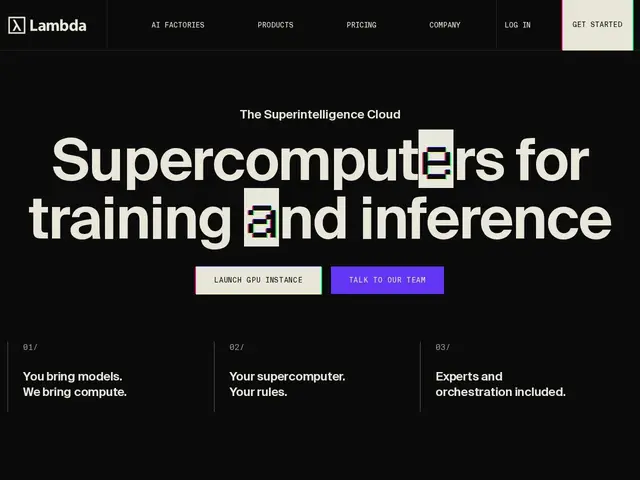
Description
Some AI teams just need to rent one GPU for an afternoon of experimenting; others need tens of thousands of GPUs working together for months to train a frontier model. Most cloud providers are built for one end of that spectrum or the other. Lambda (formerly Lambda Labs), founded in 2012, was built by a team with a research background specifically to serve both — from single instances to some of the largest GPU superclusters that exist. Lambda provides dedicated, single-tenant GPU cloud infrastructure that scales from one GPU up to superclusters exceeding 165,000 GPUs, with "1-Click Clusters" available on commitments from two weeks to a year, and longer multi-year supercluster contracts for the largest customers. It's SOC 2 Type II certified and markets fast provisioning (in minutes rather than days). Its customer base spans hyperscalers, regulated enterprises, frontier AI labs, startups, researchers and government. Pricing runs roughly $0.79-$6.99 per GPU-hour for standard instances depending on GPU generation, with dedicated B200 clusters priced around $8.87-$9.86 per GPU-hour for 16-256+ GPU configurations.
💬 Our review
The short version: Lambda's 2012 founding and research-first origins give it real credibility with the frontier-lab and academic crowd that RunPod and CoreWeave court less directly — being able to scale credibly from a single researcher's GPU to a 165,000-GPU supercluster in one company is a genuinely unusual range.
The honest trade-off against RunPod is price at the small end: Lambda's standard instance pricing ($0.79-$6.99/hr) overlaps with but doesn't clearly undercut RunPod's cheaper self-serve tiers, so a solo developer optimizing purely for lowest cost may still find RunPod's flexible, contract-free pricing more attractive. Where Lambda pulls ahead is at the large-cluster end — 1-Click Clusters and multi-year supercluster contracts are aimed at serious, sustained training runs that need guaranteed, single-tenant capacity, a use case RunPod's community-cloud model isn't built for. For research teams and companies planning a real training run at meaningful GPU count, Lambda's cluster commitments are worth pricing out directly against CoreWeave's comparable enterprise offering.
💰 Pricing
📊 Global score
🤖 AI-enriched data
Pros
Scales from a single GPU to superclusters exceeding 165,000 GPUs
Research-first origins (founded 2012) with strong credibility among AI labs
Fast provisioning (minutes) and SOC 2 Type II certification
Cons
Standard pricing doesn't clearly undercut RunPod's cheaper self-serve tiers
Larger commitments (1-Click Clusters, superclusters) require longer-term contracts
Best value is at large-cluster scale, less differentiated for small, short-term rentals
❓ Frequently asked questions
- Can I rent just one GPU from Lambda, or is it enterprise-only?
- Both — Lambda scales from single-GPU instances up to superclusters exceeding 165,000 GPUs, serving individual researchers as well as hyperscale enterprise customers.
- What is a 1-Click Cluster?
- A dedicated multi-GPU cluster you can provision with commitments ranging from two weeks to one year, aimed at teams running a real training job rather than one-off experimentation.
- How is Lambda different from a hyperscaler like AWS for GPUs?
- Lambda was founded in 2012 with a research-first focus specifically on GPU infrastructure for AI, generally offering simpler, more transparent pricing than navigating a hyperscaler's broader cloud platform.
- Is Lambda compliant enough for regulated industries?
- It's SOC 2 Type II certified, and lists regulated enterprises among its customer base.
- Is it worth the money compared to alternatives?
- For short, small-scale rentals, RunPod's pricing is often more competitive. Lambda's value shows up at larger scale — 1-Click Clusters and superclusters for serious, sustained training runs — worth pricing out directly against CoreWeave if you're planning a large training job.
- Which tool should you pick for your case?
- Planning a large-scale, sustained GPU training run: Lambda's clusters. Need the cheapest, most flexible self-serve GPU access: RunPod. Need enterprise-grade dedicated capacity with the broadest hyperscaler-adjacent feature set: CoreWeave.