CoreWeave
Enterprise cloud built specifically around NVIDIA GPUs, providing large-scale compute for training and running the biggest AI models.
🔗 Visit CoreWeave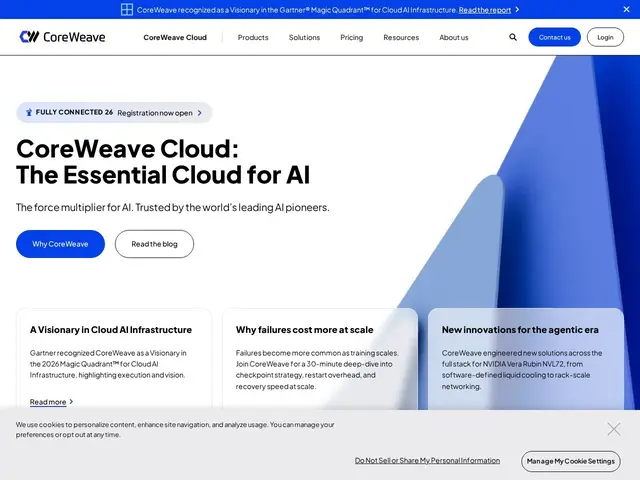
Description
Training or running the largest AI models needs an enormous amount of specialized computing power — thousands of top-tier graphics cards working together, with the storage and networking to keep them fed with data without becoming the bottleneck. CoreWeave built its entire cloud platform around exactly that need, rather than adapting general-purpose cloud infrastructure originally designed for websites and databases. CoreWeave is a cloud infrastructure company purpose-built around NVIDIA GPUs — from H100 and Hopper-generation chips through the newer Blackwell and Vera Rubin generations — sold in NVIDIA HGX 8-GPU node bundles rather than individual cards. It offers Kubernetes management with a free control plane (built on its SUNK service), tiered AI object storage across hot, warm, cold and archive levels with zero egress fees, spot instances at roughly a 50% discount versus on-demand pricing, and Mission Control tooling for observability and security automation. On-demand H100 pricing runs around $6.16 per GPU-hour (sold as an 8-GPU node at roughly $49.24/hour total), with reserved capacity able to cut on-demand pricing by up to 60%. CoreWeave's customers include OpenAI, Mistral AI, IBM, Google, Cloudflare and AI platforms like Fireworks AI, and the company went public in 2025.
💬 Our review
The short version: CoreWeave earns its enterprise reputation honestly — being trusted by OpenAI, Mistral AI and Google for GPU capacity is a real signal of reliability at the scale that matters most, and the zero-egress-fee storage and free Kubernetes control plane remove cost traps that hyperscalers are notorious for.
At roughly $6.16/GPU-hour for H100 on-demand, CoreWeave sits meaningfully above cheaper self-serve options like RunPod ($1.99-$2.39/hr for comparable H100 capacity) and above general market comparisons showing rates as low as $1.49/hr elsewhere — the premium buys guaranteed dedicated hardware and enterprise-grade reliability rather than commodity spot capacity, which is a real trade worth making for production workloads at a company like OpenAI's scale, but a real cost for a smaller team that doesn't need that guarantee. Reserved capacity cutting up to 60% off on-demand narrows the gap significantly for teams willing to commit, which is the sensible path if CoreWeave's reliability profile is the deciding factor; for short-term or budget-constrained experimentation, RunPod or Spheron-style spot markets remain meaningfully cheaper.
💰 Pricing
📊 Global score
🤖 AI-enriched data
Pros
Trusted by major AI labs (OpenAI, Mistral AI, Google, IBM) at production scale
Zero egress fees on storage and a free Kubernetes control plane
Reserved capacity can cut on-demand pricing by up to 60%
Cons
On-demand pricing (~$6.16/GPU-hr) is notably higher than RunPod's cheapest tiers
GPUs sold in 8-GPU node bundles, not individual cards, less flexible for small workloads
Enterprise positioning means less self-serve simplicity than RunPod
❓ Frequently asked questions
- Can I rent a single GPU from CoreWeave?
- No — CoreWeave sells H100 and H200 GPUs exclusively as NVIDIA HGX 8-GPU node bundles, not individual cards, which is different from more flexible providers like RunPod.
- Why do major AI labs like OpenAI use CoreWeave?
- CoreWeave built its entire cloud specifically around large-scale NVIDIA GPU infrastructure, with guaranteed dedicated capacity and enterprise-grade reliability that's harder to get from commodity or spot-market GPU providers.
- Does CoreWeave charge for moving data out of storage?
- No — its tiered AI object storage has zero egress fees, which avoids a cost trap common with major hyperscalers.
- How much cheaper is reserved capacity?
- Reserved capacity can cut on-demand pricing by up to 60%, and spot instances offer roughly a 50% discount versus standard on-demand rates.
- Is it worth the money compared to alternatives?
- At roughly $6.16/GPU-hour on-demand for H100, CoreWeave costs more than RunPod's cheapest self-serve tiers ($1.99-$2.39/hr). The premium is worth it for production workloads that need guaranteed dedicated capacity and enterprise-grade reliability; for short-term or budget-constrained experimentation, RunPod is meaningfully cheaper.
- Which tool should you pick for your case?
- Running production AI workloads at enterprise scale with reliability guarantees: CoreWeave. Need the cheapest, most flexible self-serve GPU access: RunPod. Want research-friendly workflows scaling to large clusters: Lambda.