Inkbox
Gives AI agents their own email address, phone number and iMessage identity, so they can send, receive and act on real-world communication.
🔗 Visit Inkbox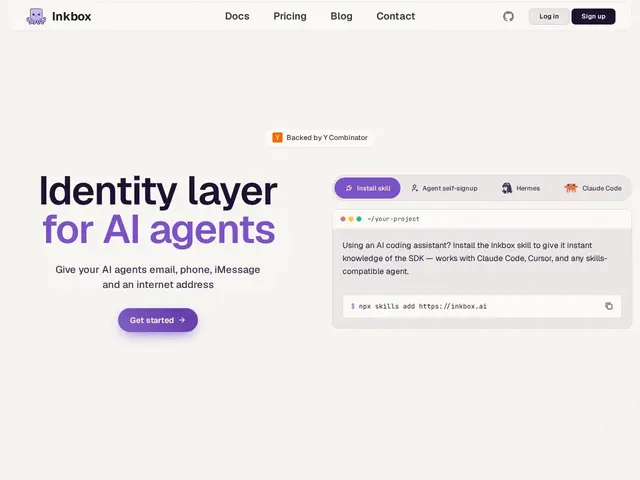
Description
An AI agent that's supposed to book a restaurant, follow up with a customer, or coordinate over email needs something a chatbot in a browser tab doesn't have: an actual email address, phone number, or way to receive a text message back. Normally a developer would have to wire together several separate services just to give an agent that basic reach into the outside world. Inkbox packages all of that into one identity an agent can own — its own email, phone, and iMessage presence, plus a place to remember what happened across all of them. Inkbox provides API-first communication infrastructure for AI agents: provisioned email addresses with IMAP/SMTP access and custom sending domains, real phone numbers for SMS, MMS and voice calls with real-time streaming, iMessage integration, and public HTTP tunnels with WebSocket and TCP routing so an agent can be reached from outside its own environment. It also includes an encrypted vault for credentials and a shared contacts layer, so context (who the agent has talked to, what was said) persists across channels rather than resetting with every session. Inkbox ships Python and TypeScript SDKs and is a Y Combinator S26 (2026) company. Pricing starts free for 3 agents, then Developer at $30/month (10 agents), Startup at $200/month (100 agents), and custom Enterprise, with overage charges of $0.03 per SMS and $0.03 per minute of calls.
💬 Our review
The short version: Inkbox is solving real integration pain — stitching together email, SMS and voice for an agent normally means separate accounts with Twilio, a transactional email provider and custom webhook plumbing, and Inkbox bundles all of that behind one API built specifically for agent use cases.
The honest comparison is against building it yourself on Twilio plus a transactional email service: that combination is more mature, more widely documented, and cheaper at very high volume, but it wasn't designed around agent-specific concerns like shared context across channels or an agent needing its own persistent identity rather than a one-off phone number. As a brand-new YC S26 company, Inkbox is the newer and riskier bet — worth taking specifically if the multi-channel, agent-native identity model saves real integration time; a team that only needs simple transactional SMS or email, with no cross-channel context requirement, is likely better served by Twilio directly at a lower price.
💰 Pricing
📊 Global score
🤖 AI-enriched data
Pros
One API covers email, phone/SMS, voice and iMessage instead of stitching several providers together
Shared context/vault across channels — agent memory doesn't reset per channel
Free tier covers 3 agents to prototype at no cost
Cons
Very young company (2026 YC batch), unproven at scale
Twilio-plus-email-provider is more mature and cheaper at very high volume
Overage pricing ($0.03/SMS, $0.03/min) adds up fast for high-communication-volume agents
❓ Frequently asked questions
- Why would an AI agent need its own email or phone number?
- Some tasks — booking an appointment by email, receiving a text confirmation, following up with a customer — require a real communication channel the agent owns, not just a chat window in a browser tab.
- Does Inkbox remember context across channels?
- Yes — it maintains a shared contacts and context layer, so if an agent talked to someone by email, it can reference that when a text or call comes in on the same thread.
- Is Inkbox open source?
- The client SDKs (Python and TypeScript) are open source; the underlying communication infrastructure itself is a hosted commercial platform.
- How much does it cost to send messages beyond the plan limits?
- Overages are billed at $0.03 per SMS and $0.03 per minute of voice calls, on top of the monthly plan fee.
- Is it worth the money compared to alternatives?
- For an agent that needs multiple channels (email, SMS, voice, iMessage) with shared context, Inkbox saves real integration time versus wiring together Twilio and a separate email provider yourself. For a simple, single-channel need like transactional SMS only, Twilio directly is usually cheaper.
- Which tool should you pick for your case?
- Building an agent that needs a persistent identity across email, SMS, voice and iMessage: Inkbox. Just need reliable SMS/voice at scale and don't need cross-channel memory: Twilio. Just need transactional email: SendGrid.