Daytona
Sandboxed cloud execution infrastructure for AI agents to safely run code in under 90ms, across Python, TypeScript, Go, Ruby and Java.
🔗 Visit Daytona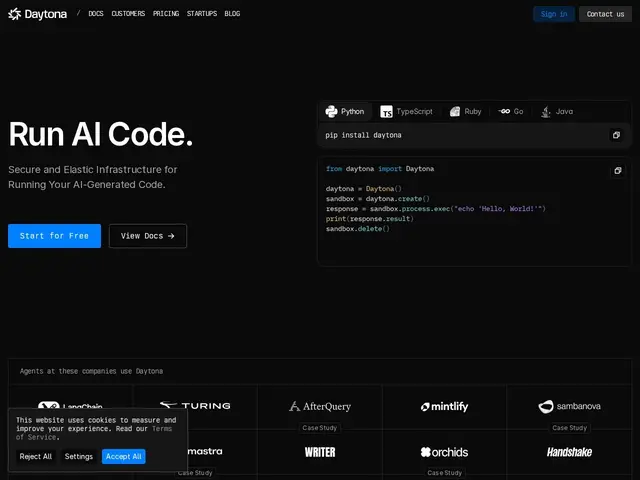
Description
An AI coding agent that writes code is only half useful if it can't actually run that code somewhere to check it works — and letting an AI agent execute arbitrary code on your own machine is a real security risk. Daytona solves that by giving every agent its own disposable, isolated computer in the cloud that spins up in under a tenth of a second, runs the code, and can be thrown away afterward. Daytona provides secure, isolated sandbox infrastructure for executing AI-generated code across Python, TypeScript, Ruby, Go and Java, with sandbox creation times under 90 milliseconds. It supports process execution, file system operations, Git integration, and Language Server Protocol features, plus environment snapshots for persisting state and "Computer Use" capabilities for automating full Linux, macOS or Windows desktops. It's open source (AGPL, 72,000+ GitHub stars) with customers including LangChain, Turing and SambaNova, and raised a $24M Series A in February 2026.
💬 Our review
The short version: Daytona is infrastructure for teams building AI agent products that need those agents to actually execute code safely, not just suggest it — think code interpreters, autonomous coding agents, or automated data analysis tools.
The headline number — sub-90ms sandbox creation — matters specifically because agent workflows often need to spin up and tear down execution environments constantly (test this, try that), and slow cold starts break the feel of an agentic product. Against E2B, its most direct competitor, Daytona's pitch leans on its open-source AGPL codebase (72k+ GitHub stars) and broader language support, while E2B has a longer track record in the specific 'AI code interpreter' niche. The honest trade-off is that Daytona is developer infrastructure, not a consumer product — you're paying pay-as-you-go compute costs on top of whatever AI model calls it, and it only makes sense if you're actually building an agent that needs to execute untrusted code, not just call an LLM API. For teams building coding agents, data analysis copilots, or anything that needs to safely run AI-generated code, Daytona is a serious, well-funded option; for most other AI product ideas it's simply unnecessary infrastructure.
💰 Pricing
📊 Global score
🤖 AI-enriched data
Pros
Sub-90ms sandbox creation time, built for agentic workflows that spin environments up/down constantly
Open source under AGPL with 72,000+ GitHub stars
Multi-language support (Python, TypeScript, Ruby, Go, Java) plus Computer Use for full desktop automation
$24M Series A (Feb 2026) with customers like LangChain and SambaNova
Cons
Pay-as-you-go compute costs are on top of whatever LLM API calls it
Only useful for products that actually need to execute untrusted AI-generated code
Competes directly with E2B, which has a longer track record in the code-interpreter niche
❓ Frequently asked questions
- What problem does Daytona actually solve?
- It gives AI coding agents a safe, disposable place to run code — so an agent can execute what it wrote, see if it works, and iterate, without that code touching your own infrastructure.
- Why does sub-90ms sandbox creation matter?
- Agentic workflows often spin sandboxes up and down repeatedly during a single task, so slow cold starts directly hurt the responsiveness of an AI product built on top of it.
- Is Daytona open source?
- Yes — it's licensed under AGPL and has over 72,000 GitHub stars, with a managed cloud offering built on top of the open-source core.
- What languages does it support?
- Python, TypeScript, Ruby, Go and Java for code execution, plus "Computer Use" capabilities for automating full Linux, macOS or Windows desktop environments.
- Is it worth the money compared to alternatives?
- Daytona's pay-as-you-go pricing is comparable to E2B's, so the choice usually comes down to fit rather than price: Daytona's open-source AGPL codebase and broader language/OS support can be worth it if you want to self-host or need Computer Use automation, while E2B's longer track record in the code-interpreter space may weigh more for teams that want proven maturity.
- Which tool should you pick for your case?
- Building an AI coding agent that needs to execute code and want open-source flexibility: Daytona. Need the most established AI code-interpreter sandbox: E2B. Need general serverless compute for AI workloads beyond sandboxing: Modal. Need a human-facing cloud dev environment, not agent sandboxes: Coder or DevPod.