AutoMQ
Kafka-compatible streaming platform that runs diskless on cloud object storage (S3/GCS/Azure Blob), cutting Kafka's infrastructure cost sharply while keeping full API compatibility.
🔗 Visit AutoMQ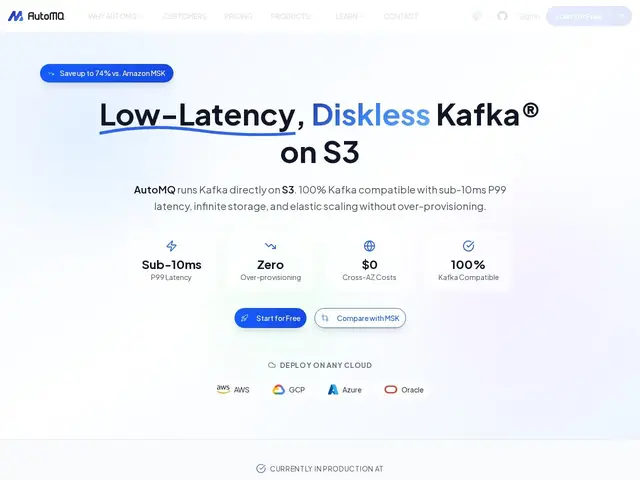
Description
Apache Kafka is the standard way apps stream data to each other in real time, but running it yourself means managing expensive disks, cross-availability-zone network fees, and manual capacity planning that never quite matches actual traffic. AutoMQ keeps everything that works about Kafka — the same API, the same client libraries — but replaces the disks underneath with plain, cheap cloud object storage, cutting the operational cost dramatically without anyone having to touch their existing Kafka code. AutoMQ is a cloud-native, 100% Kafka-API-compatible streaming platform that writes data directly to S3, GCS or Azure Blob storage instead of local disks, using a stateless broker design. This diskless architecture enables instant failover and partition reassignment in seconds, eliminates cross-AZ data transfer costs, and claims up to 74% cost reduction versus Amazon MSK. It's open source (Apache 2.0, 10,000+ GitHub stars) with a managed cloud tier, and used in production by companies like Grab, Tencent and JD.com.
💬 Our review
The short version: AutoMQ is worth evaluating if you're already running Kafka and tired of paying for over-provisioned disks and cross-AZ network fees just to keep it available.
Because it's a drop-in replacement rather than a new protocol, teams keep every existing Kafka client, connector and tool — the switching cost is mostly operational, not a rewrite, which is a genuinely different proposition from adopting Redpanda or Pulsar (which require re-pointing to a different ecosystem). The core bet is that object storage is reliable and cheap enough to be Kafka's primary disk, a bet also being made by competitors like Bufstream and WarpStream — AutoMQ differentiates on being open source with a real self-hosted path, not just a managed SaaS. The honest caveat is that diskless Kafka architectures are still relatively new (all of these projects are a few years old at most), so teams with extremely latency-sensitive workloads should benchmark carefully rather than assume parity with disk-based Kafka; for most standard streaming workloads the cost savings are the more relevant story than the sub-10ms latency claims.
💰 Pricing
📊 Global score
🤖 AI-enriched data
Pros
100% Kafka API compatible — existing clients, connectors and tools keep working unchanged
Claims up to 74% cost reduction vs. Amazon MSK via diskless object-storage architecture
Open source (Apache 2.0) with 10,000+ GitHub stars and a genuine self-hosted path
Zero cross-AZ data transfer costs and automatic elastic scaling
Cons
Diskless Kafka architecture is still young — worth benchmarking for latency-critical workloads
Managed Pro tier starts at $300/month base before usage costs
Competing directly with well-funded alternatives (Redpanda, WarpStream, Bufstream) in a fast-moving space
🔄 Alternatives to AutoMQ
See all alternatives to AutoMQ →❓ Frequently asked questions
- Do I need to rewrite my Kafka applications to use AutoMQ?
- No — AutoMQ is 100% Kafka API compatible, so existing producers, consumers, connectors and tooling work unchanged; you're swapping the underlying broker infrastructure, not the protocol.
- How does it actually save money over Kafka?
- It writes data directly to cheap cloud object storage (S3/GCS/Azure Blob) instead of provisioned disks, and its stateless broker design eliminates the cross-AZ replication traffic that drives up costs in standard Kafka clusters.
- Can I self-host AutoMQ for free?
- Yes — the core project is open source under Apache 2.0 and available on GitHub with 10,000+ stars; the managed cloud service is a paid option on top.
- Is it production-ready?
- It's used in production by companies like Grab, Tencent and JD.com, though as with any diskless Kafka implementation (a category only a few years old), latency-critical workloads should be benchmarked before full migration.
- Is it worth the money compared to alternatives?
- AutoMQ's open-source self-hosted tier is free, undercutting the cost of Amazon MSK or Confluent Cloud outright; the managed Pro tier at $300/month plus usage is still typically cheaper than MSK at scale according to AutoMQ's own benchmarks, though every team should validate against their own traffic pattern before switching.
- Which tool should you pick for your case?
- Already running Kafka and want to cut infrastructure cost without a rewrite: AutoMQ. Want a fully managed Kafka-compatible SaaS with less ops: Confluent Cloud or WarpStream. Need a from-scratch alternative with a different protocol: Redpanda. Need Buf's schema-registry integration specifically: Bufstream.