Routable
Accounts-payable automation and mass-payout platform with a developer API, handling vendor payments, invoice OCR, and tax forms at volume.
🔗 Visit Routable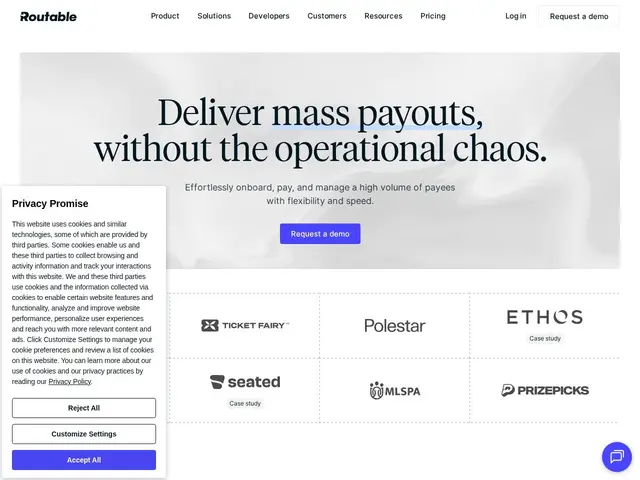
Description
Paying one vendor is simple. Paying thousands of vendors or contractors every month — each with their own tax forms, currencies and bank details — is the kind of operational grind that eats a finance team's week. Routable automates that grind: it reads invoices automatically, codes them to the right account, and sends the money, in whatever currency the recipient needs. Routable is a fintech platform for accounts-payable automation and mass payouts, processing payments to 220+ countries in 140+ currencies. It uses AI-powered OCR to read incoming invoices and auto-code them to the right accounts (claiming up to 80% time savings), handles vendor onboarding and compliance checks, generates tax forms (W-9, W-8, 1099, 1042), and integrates with NetSuite, QuickBooks, Xero and Sage. Developers can integrate directly via a RESTful Payments API instead of the web dashboard, for platforms that need to embed payouts into their own product.
💬 Our review
The short version: Routable is built for finance teams and marketplaces that need to pay a lot of vendors or contractors reliably, not for a startup that pays five vendors a month by hand.
What separates it from a generic payments API like Stripe Connect is the AP-automation layer bolted on top of the payouts: the invoice OCR, auto-coding, and tax-form generation (W-9/1099s) are built for a finance team's actual workflow, not just a developer wiring up a payout endpoint. That focus is also its limitation — Routable doesn't publish pricing, meaning you go through a sales process before knowing what it costs, and for a company that only needs raw payout rails without the AP/accounting layer, a leaner API like Trolley or a direct Stripe integration is simpler. For marketplaces, gig platforms or agencies drowning in vendor invoices and 1099 season, the automation is worth the sales call; for a lean payments integration, it's more platform than you need.
💰 Pricing
📊 Global score
🤖 AI-enriched data
Pros
AI-powered invoice OCR with automatic bill coding (claimed 80% time savings)
Handles 220+ countries and 140+ currencies for vendor payouts
Automates tax form generation (W-9, W-8, 1099, 1042)
Integrates with NetSuite, QuickBooks, Xero and Sage
Cons
No public pricing — requires a sales conversation to get a quote
More AP-automation platform than a lean payments API, if all you need is payout rails
Best suited to companies already dealing with vendor-management overhead, not simple one-off payments
🔄 Alternatives to Routable
See all alternatives to Routable →❓ Frequently asked questions
- What does Routable actually automate?
- It reads incoming vendor invoices with AI-powered OCR, automatically codes them to the right accounts, handles vendor onboarding/compliance, and pays out to 220+ countries — plus generates tax forms like 1099s.
- Can developers integrate Routable directly, not just use the dashboard?
- Yes — Routable offers a RESTful Payments API for platforms that want to embed payouts into their own product rather than using the web interface.
- Does it work for international payments?
- Yes — it supports payouts to 220+ countries in 140+ currencies, with claimed rates cheaper and faster than many competitors.
- How much does Routable cost?
- Pricing isn't published publicly — you need to contact sales to get a quote based on your payment volume.
- Is it worth the money compared to alternatives?
- Against a lean payout API like Trolley, Routable costs more because you're also paying for the AP-automation layer (invoice OCR, tax forms, vendor compliance). If your team is manually processing vendor invoices today, that automation usually pays for itself; if you only need raw payout rails, a simpler API is cheaper.
- Which tool should you pick for your case?
- Finance team drowning in vendor invoices and 1099 season: Routable or Tipalti. Marketplace needing to embed payouts to contractors: Trolley or Stripe Connect. Small business paying a handful of vendors: Bill.com or Melio.