SigNoz
Open-source observability platform that unifies traces, metrics and logs in one OpenTelemetry-native tool, self-hosted or cloud.
🔗 Visit SigNoz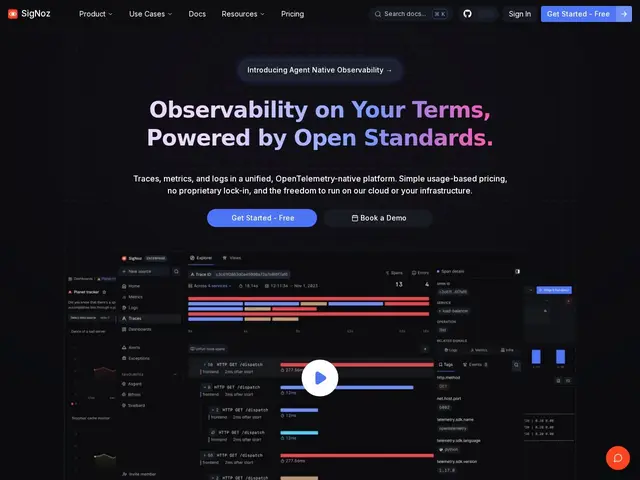
Description
When something breaks in a piece of software running on a server, engineers need a way to see what happened — which request failed, how long it took, what the system was doing at that moment. That's called "observability," and most companies pay a separate tool for each piece of it (one for logs, one for performance, one for errors). SigNoz puts all of that in one free, open-source tool you can run on your own servers instead of paying per gigabyte to a vendor. SigNoz is an open-source observability platform built natively on OpenTelemetry, the industry-standard instrumentation format. It stores traces, metrics and logs together in a single ClickHouse-backed datastore, so an engineer can jump from a slow API call to its logs to the underlying infrastructure metrics without switching tools. It covers APM (P99 latency, Apdex, database call tracking), distributed tracing at scale (up to 1 million spans per trace), Kubernetes and infrastructure monitoring, and LLM observability for OpenAI, Gemini and Anthropic-backed applications. The self-hosted Community Edition is MIT-licensed and free; SigNoz Cloud starts at $49/month, with usage-based pricing for traces/logs ($0.30/GB) and metrics ($0.10/million samples), scaling to Enterprise at roughly $4,000/month.
💬 Our review
The short version: if your team is paying Datadog or New Relic by the gigabyte and mostly just wants traces, logs and dashboards in one place, SigNoz gives you that for free if you're willing to self-host, or a fraction of the price if you're not.
SigNoz's core bet is that OpenTelemetry has won as the instrumentation standard, so it built the whole platform around ingesting OTel data natively rather than bolting it on — which shows up in cleaner correlation between traces, logs and metrics than most retrofitted tools manage. 31.3k GitHub stars and an MIT-licensed core back up that it's a real, actively maintained project, not an abandoned side project. The honest trade-off: it's dual-licensed, meaning the fully-loaded enterprise feature set (advanced RBAC, certain AI features) sits behind a commercial tier, and self-hosting ClickHouse at scale is real operational work that a fully-managed Datadog plan avoids. For a startup or mid-size engineering team comfortable running their own infrastructure, SigNoz is a legitimate way to cut an observability bill by the claimed 80%; teams that want zero-ops and don't mind enterprise pricing are better served staying with Datadog or Dynatrace.
💰 Pricing
📊 Global score
🤖 AI-enriched data
Pros
Free, MIT-licensed, self-hostable core with no data caps
OpenTelemetry-native — traces, logs and metrics correlated in one datastore
Handles high-cardinality tracing (up to 1M spans/trace)
Cons
Self-hosting ClickHouse at scale is real ops work
Full enterprise feature set requires the paid tier
❓ Frequently asked questions
- Can I run SigNoz entirely on my own infrastructure for free?
- Yes — the Community Edition is MIT-licensed and self-hosted via Docker or Kubernetes with no data caps, though you're responsible for running and scaling ClickHouse yourself.
- Does SigNoz require OpenTelemetry instrumentation?
- It's built OpenTelemetry-native, so OTel is the primary and recommended path, though it also accepts data from some other collectors and legacy formats.
- What's the difference between the free and paid tiers?
- The free Community Edition has the full observability core (traces, logs, metrics, APM). The paid Cloud and Enterprise tiers add managed hosting, higher scale, advanced RBAC, and some AI-assisted debugging features.
- Is it worth the money compared to alternatives?
- Self-hosting the Community Edition is free versus Datadog's per-gigabyte pricing that commonly runs into thousands per month at scale — worth it if you can absorb the ops overhead. If you want fully managed with zero infrastructure work, Datadog or Honeycomb's cloud pricing may work out similar once you factor in your own DevOps time.
- Which observability tool should you pick for your case?
- Want a free, self-hosted, all-in-one stack and can run ClickHouse: SigNoz Community Edition. Want fully-managed with the broadest ecosystem and don't mind enterprise pricing: Datadog. Want the best AI/LLM-era tracing UX and don't need self-hosting: Honeycomb. Want open-source with a bigger existing Grafana investment: Grafana Cloud/Tempo.