Modal
Serverless cloud platform that runs Python code, including AI model training and inference, on GPUs with sub-second startup and pay-per-second billing.
🔗 Visit Modal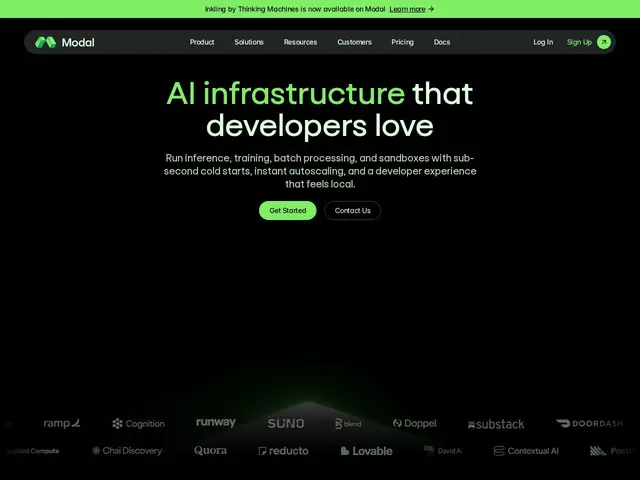
Description
Renting a GPU server and leaving it running 24/7 just in case you need to train or run an AI model is like leaving a rental car idling in the driveway all month — expensive and wasteful. Modal lets developers write ordinary Python code, add a decorator, and have it run on a cloud GPU only for the seconds it's actually doing work, then disappear automatically — no server to manage, no idle bill. Modal is a serverless compute platform aimed at AI/ML workloads: model inference, training, fine-tuning, batch processing and sandboxed code execution. It defines infrastructure as Python code via its SDK, offers sub-second cold starts and automatic autoscaling across GPU types (T4, A100, H100, B200, B300), and runs across a globally distributed multi-cloud backend with SOC2 and HIPAA compliance for regulated workloads. Billing is per-second for exactly the compute used — GPUs from $0.000164/sec, CPU from $0.0000131/core/sec — with no charge for idle resources. The Starter plan is free with $30/month in compute credits; Team is $250/month plus compute costs with $100/month in credits; Enterprise is custom with volume discounts.
💬 Our review
The short version: if your team's AI workloads are bursty — a training job here, a batch inference run there — Modal charges you only for the seconds a GPU actually runs, instead of the hours it sits idle on a reserved cloud instance.
Modal's core technical achievement is sub-second cold starts on GPU-backed containers, which is genuinely hard — most serverless GPU platforms take tens of seconds to spin up a container with a large model loaded, breaking the serverless promise for latency-sensitive inference. Defining infrastructure directly in Python (rather than YAML or a separate IaC tool) also lowers the barrier for ML engineers who aren't DevOps specialists. The honest trade-off: only the client SDK is open source (Apache-2.0) — the platform itself is proprietary and you're fully dependent on Modal's infrastructure, unlike self-hosted alternatives, and per-second GPU billing can still add up for genuinely constant, always-on inference traffic where a reserved instance would be cheaper. For teams with spiky or unpredictable AI compute needs, Modal removes a lot of DevOps overhead; teams running 24/7 high-volume inference at predictable scale should compare against reserved GPU pricing from a raw cloud provider.
💰 Pricing
📊 Global score
🤖 AI-enriched data
Pros
Sub-second cold starts on GPU-backed containers
Infrastructure defined as plain Python code, not YAML
Pay-per-second billing with zero idle-resource charges
Cons
Platform itself is proprietary — only the client SDK is open source
Always-on, high-volume inference may be cheaper on reserved instances
❓ Frequently asked questions
- Do I need to manage servers or containers with Modal?
- No — you write Python functions, decorate them to specify what GPU/CPU/memory they need, and Modal handles provisioning, scaling and teardown automatically.
- How fast does a GPU container actually start?
- Modal advertises sub-second cold starts, which is unusually fast for GPU-backed serverless — most competing platforms take several seconds to tens of seconds to load a large model into a fresh container.
- Is Modal open source?
- Only the client SDK is Apache-2.0 licensed; the underlying platform and scheduler are proprietary, so you can't self-host Modal itself.
- Is it worth the money compared to alternatives?
- For bursty or unpredictable AI workloads, per-second billing with no idle charges usually beats renting a reserved GPU instance that sits idle between jobs. For constant, high-volume inference running 24/7, a reserved instance on a raw cloud provider or a dedicated inference platform like Baseten can work out cheaper — worth comparing your actual utilization.
- Which platform should you pick for your case?
- Bursty training/inference/batch jobs written in Python: Modal. Production model-serving with a managed API layer: Baseten or Replicate. Full control over a raw GPU instance you manage yourself: a cloud provider like AWS or RunPod directly.