CodeAnt AI
AI-powered security platform combining automated pentesting, code review and cloud vulnerability scanning to find and fix exploitable issues before attackers do.
🔗 Visit CodeAnt AI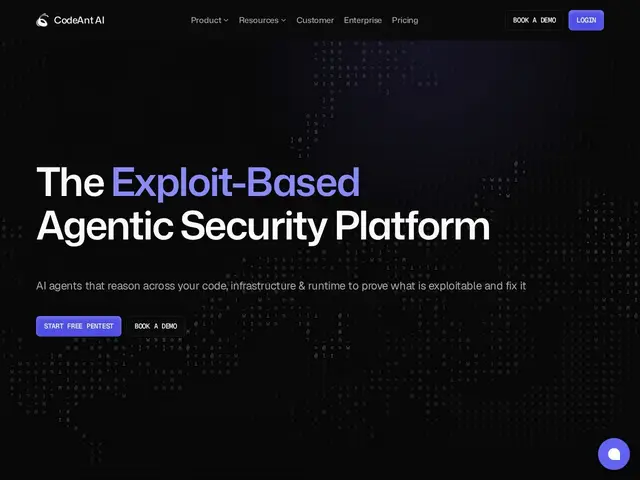
Description
Most companies find out about a security hole in their software either from a hacker or from an expensive human penetration-testing firm they hire once a year. CodeAnt AI tries to close that gap by running an AI "attacker" continuously against your own code and cloud setup, mapping out what could actually be broken into and suggesting the fix, instead of waiting for an annual audit. CodeAnt AI is an AI-powered application security platform combining agentic pentesting (autonomous attack-surface mapping and exploit attempts), AI code review of pull requests, cloud threat detection, Static and Dynamic Application Security Testing (SAST/DAST), Cloud Security Posture Management (CSPM), and third-party package vulnerability scanning, with IDE and CLI integration. It's aimed at startups through large enterprises running offensive security testing alongside day-to-day code review. Pricing includes a 14-day free trial with 100 PR reviews, a Premium tier at $24/user/month for unlimited PR reviews, and custom Enterprise pricing; open-source projects get a free tier. The company, founded by Amartya Jha and Chinmay Bharti (credited with 100+ CVE discoveries), is valued at $60M with 300+ customers as of 2026.
💬 Our review
The short version: CodeAnt AI is less a code-review tool and more a continuous, AI-driven penetration test running against your own codebase and cloud infrastructure — genuinely different from tools like Qodo or Graphite that focus on code quality rather than exploitability.
The "agentic pentesting" angle is the real differentiator: rather than static rule-based scanning (SAST/DAST alone), it actively maps attack surface and attempts exploitation the way a human red-teamer would, continuously instead of once a year. Bundling that with CSPM and package vulnerability scanning means a security team gets code-level, cloud-level and dependency-level coverage from one vendor instead of three. The honest trade-off: this is a young company (founded recently, no long public track record, no public GitHub presence to independently verify claims) in a category where false positives and false negatives both carry real cost, and $24/user/month for the Premium tier is a real line item for a mid-size engineering org. For companies wanting continuous, automated offensive security testing without hiring a full-time red team, CodeAnt AI addresses a genuine gap; teams that only need PR-quality code review (not exploit-level pentesting) may be overpaying relative to a dedicated code-review tool like Qodo.
💰 Pricing
📊 Global score
🤖 AI-enriched data
Pros
Agentic pentesting actively attempts exploitation, not just static scanning
Combines code, cloud and dependency vulnerability coverage in one platform
Founders credited with 100+ CVE discoveries
Cons
Young company with no public GitHub presence to independently verify claims
$24/user/month adds up for larger engineering teams
🔄 Alternatives to CodeAnt AI
See all alternatives to CodeAnt AI →❓ Frequently asked questions
- How is CodeAnt AI different from a standard AI code review tool?
- It's built around continuous, agentic pentesting — actively mapping attack surface and attempting exploits — with AI code review as one part of a broader security platform, rather than a code-review tool with security add-ons.
- Does it cover cloud infrastructure, not just application code?
- Yes — it includes Cloud Security Posture Management (CSPM) and cloud threat detection alongside SAST/DAST and code review, covering code, runtime and cloud configuration.
- Is CodeAnt AI open source?
- No — it's a proprietary platform with no public GitHub repositories as of 2026, so its detection claims can't be independently verified the way an open-source tool's can.
- Is it worth the money compared to alternatives?
- At $24/user/month, it's positioned between free static scanners (basic GitHub Advanced Security) and enterprise platforms like Snyk. The value case rests on the agentic pentesting capability — if you'd otherwise pay for a separate pentest engagement, it can be cost-effective; if you only need PR-level code quality checks, a dedicated tool like Qodo may be cheaper.
- Which security tool should you pick for your case?
- Want continuous automated pentesting plus code/cloud scanning: CodeAnt AI. Want mature, established dependency and code scanning: Snyk. Want deep static analysis with a long track record: SonarQube. Want AI code review focused on quality, not security: Qodo.