Octopus Deploy
Deployment orchestration that picks up where CI stops: promotes releases across environments, multi-tenant, with runbooks.
🔗 Visit Octopus Deploy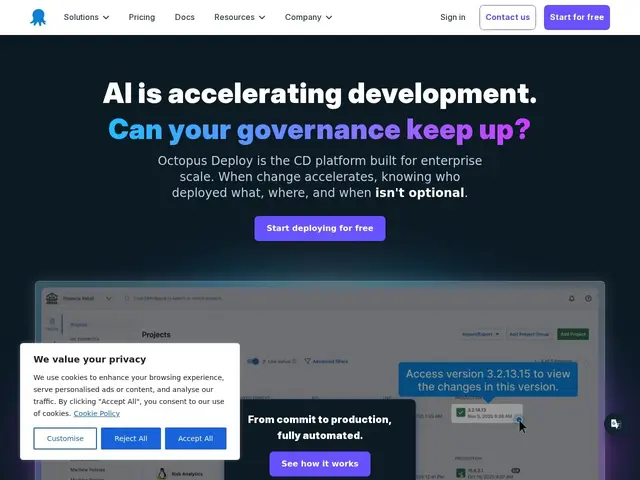
Description
Building software and actually getting it safely onto production servers, for every customer and environment, are two different problems. Octopus Deploy solves the second one: it takes a build produced by a CI tool and handles rolling it out reliably — to test, then staging, then production, and to as many customer environments as needed — with a repeatable, auditable process. Octopus Deploy is a continuous deployment platform that bridges CI tools (GitHub Actions, Azure DevOps, Jenkins, GitLab CI, TeamCity) and production environments, handling deployment scenarios that general-purpose CI/CD platforms struggle with at scale. It provides centralized orchestration across multiple environments from a single deployment process, tenanted deployments for serving many customers or locations from shared release logic, runbook automation for routine operational tasks, and over 500 pre-built step templates supporting blue/green, rolling and canary strategies. It's available as a managed Cloud (SaaS) service or a self-hosted Server, with a genuinely usable free tier (10 projects, tenants, machines and users) and paid Professional/Enterprise tiers on annual billing.
💬 Our review
The short version: once your deployments outgrow what your CI tool can safely automate — many environments, many customers, real compliance needs — Octopus Deploy is the specialist built for exactly that, though the free tier's limits will bite fast at any real scale.
Octopus Deploy's differentiator is treating deployment as its own discipline, separate from build. That distinction matters once you're deploying the same release to dozens of tenants or juggling approval gates and rollback runbooks — territory where GitHub Actions or GitLab CI alone get unwieldy. Its 500+ step templates and native support for blue/green, rolling and canary strategies reflect two decades of enterprise deployment patterns baked in, and the tenanted-deployment model is genuinely differentiated for SaaS vendors serving many customer environments. The free tier (10 projects/tenants/machines/users) is fine for evaluation but modest for production use, and pricing jumps quickly — Professional Cloud starts around $361/month, Enterprise around $2,050/month, annual billing only. For teams already comfortable wiring deployment logic into GitHub Actions or ArgoCD/GitOps, that's real money to displace a free-ish DIY setup. The honest trigger to adopt it: you're spending real engineering time building your own tenant/environment promotion logic, and paying for a tool that's already solved it looks cheaper than the alternative.
💰 Pricing
📊 Global score
🤖 AI-enriched data
Pros
Tenanted deployments for multi-customer scenarios
500+ step templates, blue/green/rolling/canary built in
Runbook automation for ops tasks
Cons
Annual billing only, real jump in cost above free tier
Adds a layer on top of your existing CI, not a replacement
🔄 Alternatives to Octopus Deploy
See all alternatives to Octopus Deploy →❓ Frequently asked questions
- Does Octopus Deploy replace my CI tool?
- No — it sits after CI, taking the build artifact and handling the deployment/promotion process. Most teams keep GitHub Actions, Jenkins or GitLab CI for the build and testing stage.
- What's a 'tenanted deployment'?
- A way to deploy the same release logic to many separate customers or locations, each with their own variables and configuration, from one shared deployment process — useful for SaaS vendors with per-customer environments.
- Can I self-host it?
- Yes, Octopus Server is a self-hosted option alongside the managed Octopus Cloud, at a lower price point for equivalent tiers.
- Is it worth the money compared to alternatives?
- The free tier is real but small (10 of everything). Professional Cloud around $361/month only makes sense once your deployment complexity (multi-tenant, compliance, many environments) exceeds what GitHub Actions or Argo CD can handle without significant custom engineering — otherwise those free/cheaper options win on cost.
- Which deployment tool should you pick for your case?
- Complex multi-tenant or highly regulated deployments: Octopus Deploy. Kubernetes-native GitOps: Argo CD. Already all-in on GitHub: GitHub Actions deploy jobs. Large-scale multi-cloud continuous delivery: Spinnaker.