Helicone
Open-source AI gateway and LLM observability: one API for 100+ models, cost and latency tracking, prompt management.
🔗 Visit Helicone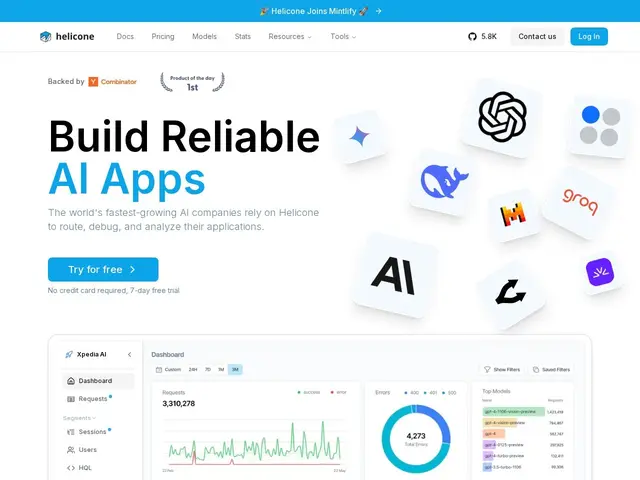
Description
Apps that use AI models send them thousands of requests, and every request costs money. Helicone sits between your app and the AI providers: it counts each request, shows what it costs and how fast it runs, and can automatically switch to a backup provider when one fails. Think of it as an electricity meter plus a switchboard for your AI usage. Helicone is an open-source AI gateway and observability platform for LLM applications. As a gateway, it fronts 100+ models behind a single API key with intelligent routing and automatic fallbacks across OpenAI, Anthropic, Gemini, Azure and others. As an observability layer, it logs every request with cost, latency and token metrics, aggregated per user, session or custom property, with an HQL query interface for deeper analysis. Around that core it adds prompt versioning, a playground for testing configurations, dataset creation from production traffic, rate limiting and alerting. Integration is typically one line — pointing your base URL at the proxy — or via async logging SDKs when you don't want a proxy in the request path. The stack (dashboard, proxy worker, Jawn processing server, Supabase, ClickHouse) is Apache 2.0 and self-hostable via Docker or Helm, and the hosted version is SOC 2 Type II and GDPR compliant with a free tier of 10,000 requests per month. Helicone is a Y Combinator W23 company, launched in 2023.
💬 Our review
The short version: the fastest way to see what your AI calls actually cost and to stop depending on a single provider — with one architectural trade-off to understand before adopting it.
Helicone's pitch is pragmatic: point your base URL at their proxy and you instantly get cost tracking, latency metrics and logs for every LLM call — no SDK rewiring. That one-line adoption is its best feature, and combining gateway (routing, fallbacks, one key for 100+ models) with observability means fewer moving parts than assembling OpenRouter plus a logging tool. The trade-offs are structural: a proxy sits in your critical path, so you inherit its latency and availability — Helicone offers async logging to avoid this, but then you lose the gateway benefits; decide which mode you actually want before adopting. The self-hosted stack is genuinely open (Apache 2.0) but non-trivial to operate — five services including ClickHouse. Its community (~6k stars) is smaller than Langfuse's, which remains the stronger pick for deep tracing of complex agent workflows; Portkey competes more directly on the gateway side. The free 10k requests/month is enough to evaluate seriously. Best fit: teams who want cost visibility and multi-provider resilience fast, with modest tracing needs.
💰 Pricing
📊 Global score
🤖 AI-enriched data
Pros
One-line proxy integration
Gateway + observability combined
Generous free tier
Cons
Proxy adds a dependency in the request path
Self-host stack is five services
❓ Frequently asked questions
- Does Helicone add latency to my LLM calls?
- In proxy mode the gateway sits in the request path, so some overhead and a dependency are inherent. If that's unacceptable, use the async logging integration instead — you keep observability but lose routing and fallbacks.
- Helicone or Langfuse?
- Helicone bundles a gateway (one key, 100+ models, fallbacks) with monitoring and is the fastest to adopt. Langfuse is SDK-based, has a larger community, and is stronger for detailed tracing of complex agent workflows. Some teams run both.
- Can I self-host it?
- Yes — the full stack is Apache 2.0 with Docker and Helm deployments, though it comprises five services including ClickHouse, so budget real ops effort.
- What does the free tier include?
- 10,000 requests per month with no credit card, enough to evaluate it on a side project or staging environment.
- Is it worth the money compared to alternatives?
- The free 10k requests/month covers evaluation and small apps; beyond that, usage-based pricing typically lands under per-seat platforms. Langfuse self-hosted is free but observability-only; Portkey charges for its gateway; OpenRouter takes a cut on routed traffic. Helicone's pricing is competitive if you actually use both halves — gateway and monitoring.
- Which LLM ops tool should you pick for your case?
- Cost visibility plus provider fallbacks, fast: Helicone. Deep tracing of complex agent workflows: Langfuse. Enterprise gateway policies and guardrails: Portkey. Just model routing with no monitoring: OpenRouter.