CrewAI
Python framework for role-based multi-agent teams: Crews plus event-driven Flows, from MIT open source to enterprise suite.
🔗 Visit CrewAI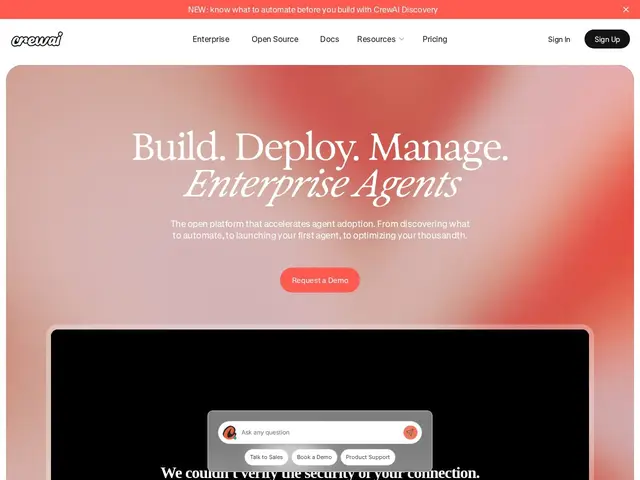
Description
CrewAI lets developers build 'teams' of AI helpers where each one has a role — one researches, one writes, one double-checks — and they collaborate on a task like a small virtual staff. It is free to use and one of the most popular ways to automate repetitive business work with AI. CrewAI is a Python framework for orchestrating teams of autonomous AI agents. Its core abstraction is the Crew: agents with defined roles, goals and tools that collaborate on a task, coordinated like a small team. For finer control, Flows provide event-driven workflow orchestration with explicit sequencing, conditions and state. The framework covers the production concerns around the agents themselves — tool integration, memory management, structured outputs, async execution with checkpointing, human-in-the-loop approval steps, and support for the MCP and A2A protocols. Typical applications include customer support automation, lead enrichment, data extraction, content generation and QA testing. The open-source framework is MIT-licensed (55k+ GitHub stars, Python 3.10-3.13) and self-hostable; a free Crew Control Plane at app.crewai.com adds management UI, and the commercial AMP Suite brings cloud or on-premise deployment, monitoring and enterprise controls. CrewAI claims adoption within a majority of Fortune 500 companies and hundreds of millions of agentic workflow executions per month.
💬 Our review
The short version: the easiest way to try multi-agent AI in Python — great for quick wins, less great when you need to understand exactly what your agents are doing and why.
CrewAI is the fastest way to get a multi-agent prototype working in Python: the role/goal/task mental model is genuinely intuitive, the MIT license is clean, and the community is enormous — 55k+ stars means answers exist for most problems. Treat the marketing numbers (60% of Fortune 500, 450M workflows a month) as marketing; what's verifiable is the healthy repo activity. The trade-off versus LangGraph is control: CrewAI's high-level abstractions do a lot behind your back, which is great until you need to debug why agents looped or burned tokens — LangGraph's explicit state graphs are more work upfront but more predictable in production. The dependency tree is heavy, and the docs oscillate between excellent and outdated. Pricing is fair: the framework costs nothing, the free control plane is usable, and AMP Suite is only worth discussing once you have real volume. Start here for prototypes and internal automations; graduate to explicit orchestration if your production behavior needs to be boringly deterministic. TypeScript teams should look at Mastra instead.
💰 Pricing
📊 Global score
🤖 AI-enriched data
Pros
Fastest multi-agent prototyping in Python
Huge community (55k+ stars)
Flows add deterministic, event-driven control
Cons
High-level abstractions hide agent behavior
Heavy dependency footprint
❓ Frequently asked questions
- What's the difference between Crews and Flows?
- Crews are role-based agent teams that collaborate autonomously on a task. Flows are event-driven workflows with explicit sequencing and state — use them when you need deterministic control around or between crews.
- Is CrewAI really free?
- The framework is MIT-licensed and free, including self-hosted production use. The free Control Plane adds a management UI; the paid AMP Suite adds enterprise deployment, monitoring and support.
- CrewAI or LangGraph?
- CrewAI is faster to prototype with and easier to learn; LangGraph gives explicit state graphs with more predictable, debuggable production behavior. Teams often prototype in CrewAI and harden in LangGraph.
- Which Python versions are supported?
- Python 3.10 through 3.13 (not yet 3.14).
- Is it worth the money compared to alternatives?
- The framework costs nothing (MIT), exactly like LangGraph and AutoGen — so choose on architecture, not price. The paid AMP Suite only enters the picture when you want managed deployment, monitoring and enterprise controls; until real volume, $0 is a realistic total.
- Which agent framework should you pick for your case?
- Prototype or internal automation in Python: CrewAI. Production workflows needing full control and debuggability: LangGraph. TypeScript stack: Mastra. Research on multi-agent conversations: AutoGen. Document-heavy RAG pipelines: LlamaIndex.