Basedash
AI-native BI: ask in plain English, get governed SQL, charts and dashboards from 750+ sources. Flat rate from $1,000/mo.
🔗 Visit Basedash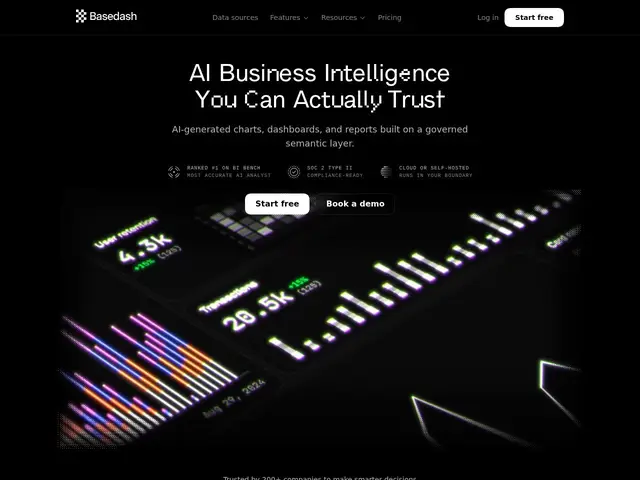
Description
Basedash lets people ask questions about their company's data in plain English — 'how many sign-ups last month?' — and get charts and dashboards back, without writing database queries or waiting for an analyst. Built-in guardrails make sure everyone gets the same, verified definitions of the numbers. Basedash is an AI-native business intelligence platform that lets teams query their data in natural language: prompts are translated into SQL against connected databases and warehouses, returning charts, dashboards and reports without hand-written queries. What separates it from generic chat-with-your-data tools is the governance layer — a semantic catalog of approved metric definitions and verified sources that constrains the AI, so two people asking the same question get the same, auditable answer. It connects to 750+ data sources, supports embedding and workflow automations, exposes an MCP server for agent integrations, and generates automated insights from connected data. Security posture is enterprise-grade: SOC 2 Type II, SSO, role-based access control, row-level security and query audit logs, with an explicit commitment not to train models on customer data, and both cloud and self-hosted deployment. Pricing is flat-rate rather than per-seat: the Startup plan at $1,000/month includes up to 25 users and monthly AI credits, with enterprise plans custom-priced. A 14-day full-feature trial requires no credit card. Basedash reports 200+ companies as customers.
💬 Our review
The short version: a credible 'ask your data anything' tool for mid-size companies — but at $1,000 a month, small teams should start with free alternatives first.
Basedash gets the hard part of AI BI right conceptually: raw text-to-SQL is a demo, not a product, because nothing stops the model from inventing a revenue definition per question. Anchoring generation to a governed semantic layer of verified metrics is the correct architecture, and flat-rate pricing including 25 users counters the per-seat creep that makes classic BI expensive precisely when adoption succeeds. SOC 2, row-level security, audit logs and a no-training commitment cover the enterprise checklist, and self-hosting is available. The honest counterweights: $1,000/month is a real floor — a five-person startup gets far more value per dollar from Metabase (open source, free) or Lightdash until non-technical query volume actually justifies it; it's closed source; the AI-credit metering adds a variable on top of the flat rate that's hard to predict before real usage; and 200+ customers means the semantic layer tooling is younger than dbt-based alternatives it conceptually competes with. Best fit: 20-200 person companies with a data warehouse, no analysts to spare, and a queue of business questions. Below that, start open source and revisit.
💰 Pricing
📊 Global score
🤖 AI-enriched data
Pros
Governed semantic layer constrains the AI
Flat rate, no per-seat creep
750+ connectors
Cons
$1,000/mo entry price
Closed source
❓ Frequently asked questions
- How is this different from asking ChatGPT to write SQL?
- Basedash constrains generation with a governed semantic layer — approved metric definitions and verified sources — so answers are consistent and auditable across users, with RLS and query logs enforcing who sees what.
- Who is the $1,000/month Startup plan for?
- Teams of roughly 10-25 people with a real data warehouse and recurring business questions but no dedicated analyst. Smaller teams usually get better value from Metabase or Lightdash first.
- Does Basedash train AI models on my data?
- No — the company explicitly commits to not training models on customer data, and offers SOC 2 Type II compliance, SSO, row-level security and audit logs.
- Can it run on our own infrastructure?
- Yes, both cloud and self-hosted deployments are offered; self-hosting details are provided during enterprise conversations.
- Is it worth the money compared to alternatives?
- At $1,000/month flat for up to 25 users, Basedash beats per-seat BI once 15+ people actually use it — but Metabase's open-source core is free forever and Lightdash is open source over dbt. The honest math: pay Basedash when AI answering genuinely replaces analyst hours; otherwise free BI plus occasional SQL help wins.
- Which BI tool should you pick for your case?
- 20-200 person company with a warehouse and no analysts: Basedash. Small team or zero budget: Metabase. dbt-centric data team wanting governed metrics: Lightdash. SQL-fluent team wanting notebooks and apps: Hex.